Overview
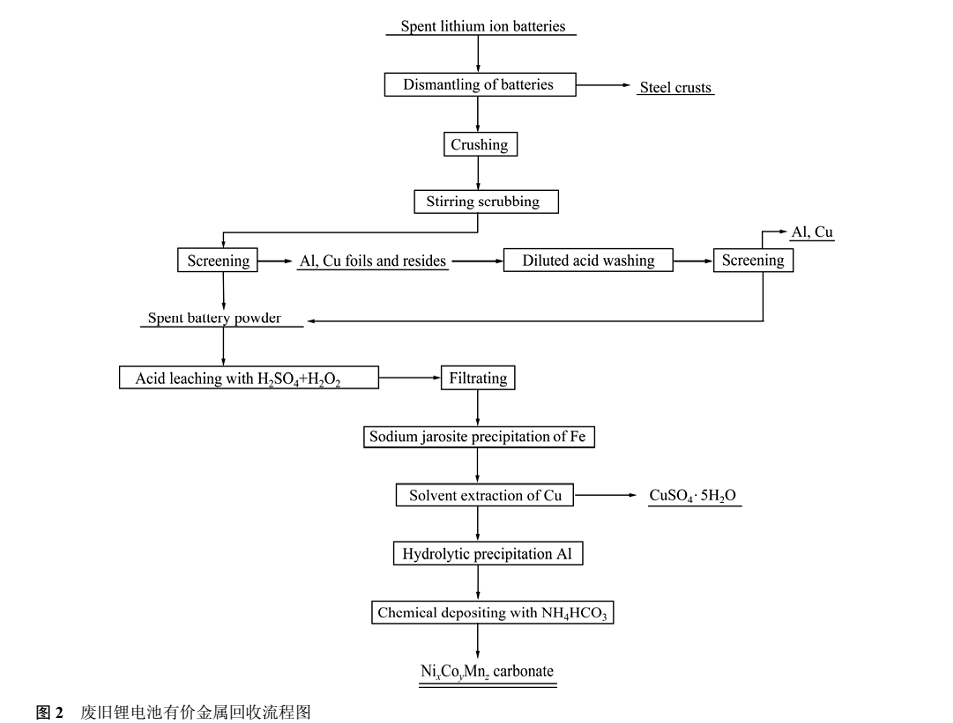
This article introduces an integrated hydrometallurgical process for recovering high-value nickel, cobalt and manganese from waste lithium-ion batteries (LIBs). The technology combines physical scrubbing and dilute acid stirring leaching to separate current collectors from cathode active powder. A sulfuric acid-hydrogen peroxide system serves as the leaching agent for active material dissolution. The pregnant leach solution is purified sequentially: sodium jarosite precipitation for iron removal, N902 solvent extraction for copper separation, and hydrolytic precipitation for aluminum elimination. Finally, nickel-cobalt-manganese carbonate precursor is manufactured via carbonate co-precipitation.
Under optimized leaching conditions (liquid-solid ratio 10:1, 2.5 mol/L H₂SO₄, H₂O₂ dosage 2.0 mL/g powder, temperature 85 ℃, leaching duration 120 min), the leaching rates reach 97% for cobalt, 98% for nickel and 96% for manganese. After impurity removal of iron, copper and aluminum, the metal losses are controlled at 1.5% (Co), 0.57% (Ni) and 4.56% (Mn). The overall recovery rate of nickel, cobalt and manganese from spent lithium-ion batteries hits 95%, suitable for scaled industrial application.
Background of Spent Lithium-Ion Battery Recycling
Since commercialization in 1990, lithium-ion batteries have been widely adopted in mobile phones, laptops, cameras and portable electronics thanks to high energy density, light weight, long cycle life and zero memory effect. Global LIB output reached 500 million units in 2000 and kept rising year by year.
However, low recycling rates lead to massive end-of-life batteries discarded directly, causing heavy environmental contamination and severe resource waste. Spent LIB cathode powder typically contains cobalt 5%–20%, lithium 5%–7% and nickel 5%–10%. Recovering cobalt, nickel, manganese and other critical metals while mitigating battery pollution has become a key industrial challenge worldwide.
Many existing lab-scale recycling routes have limitations for commercial deployment. Ultrasonic cleaning, concentrated hydrochloric acid leaching, organic solvent soaking, high-temperature calcination and multi-stage thermal treatment suffer from high energy consumption, high operating cost and serious secondary pollution. In addition, diversified cathode chemistries including LiNiO₂, NMC and LiMn₂O₄ require multi-metal separation instead of single cobalt recovery only. Our developed process targets these pain points to deliver high recovery efficiency, cost competitiveness and eco-friendly operation.
Process Principle & Workflow
1. Physical Separation of Active Material and Current Collectors
After manual shell removal, battery cores are crushed to 1–5 mm fragments. Hot water scrubbing and vibration screening separate most active powder. Dilute acid mildly etches the surface of current collectors to break interfacial bonding, followed by stirring scrubbing and secondary screening. Copper foil and aluminum foil are washed and dried for direct sale as recycled metal products; collected active powder proceeds to leaching.
2. Reductive Acid Leaching with H₂SO₄-H₂O₂
Sulfuric acid works as the main lixiviant, while hydrogen peroxide acts as reducing agent to promote dissolution of lithium cobalt oxide and NMC cathode materials. The redox reaction converts solid-phase Co³⁺, Ni³⁺ and Mn⁴⁺ into soluble divalent metal sulfates.
3. Solution Purification
- Iron removal by sodium jarosite precipitation: Adjust pH and heat the leachate, iron is precipitated as filterable sodium jarosite. Iron removal efficiency reaches 99.9% with minimal Co/Ni/Mn loss.
- Copper removal by N902 solvent extraction: N902 extractant offers good selectivity for copper at low cost, ideal for mass production. Under optimal conditions (10 vol% N902 in sulfonated kerosene, aqueous pH=1.25, O/A=1:1), copper extraction rate >99.5%. Loaded organic phase is stripped by 4 mol/L sulfuric acid to obtain concentrated copper solution.
- Aluminum removal via hydrolytic precipitation: Control solution pH at 4.3 and temperature at 95 ℃. Aluminum ions precipitate selectively while nickel, cobalt and manganese remain dissolved in the liquid phase.
4. NMC Carbonate Precursor Preparation
After full purification, trace impurities of Fe, Cu and Al are reduced to ultra-low levels. Adjust the molar ratio of Ni, Co, Mn in the purified solution and add ammonium bicarbonate for co-precipitation, producing nickel-cobalt-manganese carbonate precursor for new ternary cathode manufacturing.
Key Test Results
- Physical separation: 0.5 mol/L dilute sulfuric acid gives best separation performance between active powder and Al/Cu foils.
- Optimized leaching parameters: liquid-solid ratio 10:1, 2.5 mol/L sulfuric acid, H₂O₂ 2.0 mL/g powder, 85 ℃, 120 min. Leaching rate: Co 97%, Ni 98%, Mn 96%.
- Impurity purification performance:
- Sodium jarosite: iron removal >99.9%, Co/Ni/Mn loss <1%
- N902 extraction: copper separation rate >99.5%, low co-extraction of Ni, Co, Mn, Al
- Hydrolysis precipitation: pH=4.3, effective aluminum removal and controlled valuable metal loss
- Final recovery: Total Ni, Co, Mn recovery up to 95%.
Conclusion & Industrial Advantages
- Physical scrubbing combined with dilute acid treatment efficiently separates active material and current collectors; recovered copper and aluminum foils can be sold directly for extra revenue.
- Sulfuric acid-hydrogen peroxide leaching achieves high leaching efficiency for ternary cathode metals with controllable reagent consumption.
- Stepwise purification (jarosite iron removal, N902 copper extraction, hydrolytic aluminum precipitation) delivers excellent impurity removal and low loss of target metals.
- The whole process produces NMC carbonate precursor for battery cathode remanufacturing. Total recovery of cobalt, nickel and manganese reaches 95%.
Benefits for industrial clients:
- High metal recovery and stable precursor quality
- Moderate reaction temperature, lower energy consumption vs pyrometallurgy
- Low-cost N902 extractant, good scalability for continuous production
- Recycle copper and aluminum foils as by-products to improve project economy
- Tighter impurity control to meet battery-grade raw material requirements
Keywords
Spent lithium-ion battery recycling, hydrometallurgy, nickel cobalt manganese recovery, NMC carbonate precursor, N902 solvent extraction, sodium jarosite iron removal