
Lithium-Ion Battery Recycling Plant
— Turnkey Lithium-Ion Battery Recycling Plant
Product Overview
YuSai Machinery (Henan YuSai Precision Machinery Co., Ltd., OEM/ODM since 1995) designs and builds complete lithium-ion battery recycling systems — from a single pretreatment line to a full “battery scrap → battery-grade chemicals” hydrometallurgical plant.
The plant is delivered in two buildable phases:
- Phase 1 — Pretreatment & physical separation line (this page’s core): inert-gas-protected crushing, electrolyte drying, screening, diaphragm separation, magnetic separation, grinding and air-gravity separation. Outputs: black mass, copper granules, aluminum granules, steel shells, separator film (PP/PE).
- Phase 2 — Hydrometallurgical refining (optional): lithium-first extraction, bipolar-membrane electrodialysis (BPED), solvent extraction and crystallization. Outputs: battery-grade LiOH·H₂O, NiSO₄·6H₂O, CoSO₄·7H₂O, MnSO₄·H₂O, cathode copper.
Who it is for:
- Battery recyclers and scrap battery collectors upgrading from manual dismantling or brine discharging to automated, discharge-free processing
- E-waste and PCB recyclers adding a lithium battery line
- EV battery dismantlers and second-life operators processing end-of-life packs and modules
- Investors building a new lithium battery recycling plant — pilot scale to 50,000 t/a class EPC projects (YuSai has delivered complete process engineering for a 50,000 t/a green recycling project treating 44,000 t/a of batteries and scrap)
Why the YuSai process is different: instead of copying the “discharge in salt water → shred → sell mixed black mass” route, YuSai applies technology proven in its precious-metal refining business (electrolysis, solvent extraction P204/P507/C272, RTO off-gas treatment) to batteries. The result: no discharge wastewater, 95%+ lithium recovery (industry average 50–70%), battery-grade hydroxide directly (no lithium carbonate intermediate), and closed-loop reagent recycling — economics and ESG compliance in one line.
Recycling Value Analysis
1. What your black mass is worth (real composition data)
- Cobalt (Co): ~15.79% in ternary black mass (e.g., NCM811); < 0.5% in LFP black mass.
- Nickel (Ni): 6.94 – 20% in ternary black mass (up to 60%+ in high-nickel systems like NCM811); absent in LFP.
- Lithium (Li): ~2.5 – 4% in ternary black mass; ~3.19% in LFP black mass.
- Manganese (Mn): ~4.82% in ternary black mass.
- Copper / Aluminum: Cu 1.97 – 5%, Al ~5.13% — from current collectors and structural components.
Source: YuSai black mass market analysis (2025 data, China Nonferrous Metals Industry Association, SMM). Content varies by chemistry and brand.
2. Market and policy drivers (2025–2031 timeline)
- Global lithium battery recycling market is projected to exceed US$10 billion by 2030, with China accounting for more than half; ternary + LFP waste arisings in China alone reached an estimated 176,000 t in 2025.
- EU Battery Regulation (EU) 2023/1542 is now the compliance benchmark buyers ask about:
- Recycling efficiency for Li-ion batteries: 65% by end-2025/2026 → 70% by 2030/2031
- Material recovery: Li 50% (2027) → 80% (2031); Co/Ni/Cu 90% (2027) → 95% (2031)
- Battery Passport mandatory for EV/industrial batteries ≥ 2 kWh from 18 Feb 2027; recycled-content quotas for lithium from 2031 (6% → 12% by 2036)
- Recycling vs mining life-cycle advantage (Stanford LCA): 58–81% lower GHG, 72–88% less water, 77–89% less energy — decisive for ESG reporting and green financing.
- China’s EPR & battery traceability rules, plus US UN3480/3481 transport rules (air freight ≤ 30% state of charge), shape feedstock flows and logistics design.
3. Recovery-rate reporting by stage (honest, verifiable)
- Copper & aluminum metals (Phase 1): ≥ 98% / ≥ 96% / ≥ 95% (Cu/Al/black mass grade) — typical vendor-verified range.
- Black mass recovery: ≥ 98% (mechanical), up to 98.8% in optimized three-stage crushing + low-temperature pyrolysis.
- Separator film: ≥ 98% — PP/PE for plastic recycling.
- Hydrometallurgy metal recovery (Phase 2): Ni/Co 95–98%, Mn 90–95%, Li 80–95% — the lithium-first route lifts Li to >90%.
- By-product value upgrade: Cu & Mn recovered as cathode copper + battery-grade sulfate instead of low-value slag — unique to YuSai’s extraction route.
Rates depend on feedstock mix and configuration; every claim is validated by free raw-material testing before purchase.
Applicable Materials
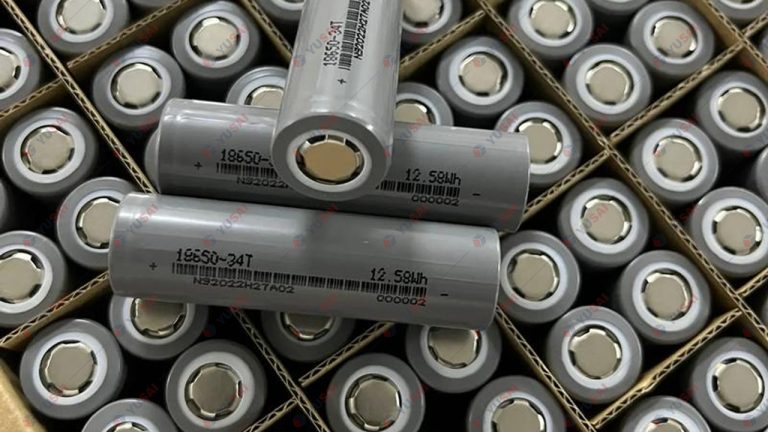
By format: pouch (soft-pack) cells · cylindrical cells (18650 / 21700 / 32650 etc.) · prismatic (steel / aluminum shell) cells · 3C (phone, laptop, power-bank) batteries
By chemistry: ternary NCM / NCA · LFP (LiFePO₄) · LMO · LCO
By source: EV / HEV packs and modules (after module-level dismantling or within validated pack envelope) · e-bike / e-scooter batteries · consumer electronics · ESS batteries · cell production scrap (defective cells, anode/cathode coated-foil offcuts) · nickel-containing residues (Phase 2)
Feed forms: whole cells or modules (discharge-free charged crushing within the validated feed envelope), dismantled cells, or electrode scrap. Sorting by shell type and chemistry at the line head optimizes every downstream step. Clear boundary: the line processes lithium-ion chemistries only — lead-acid, NiMH and other chemistries require dedicated equipment (we supply those lines too). Not every battery state can enter without pre-treatment; see section precautions (operation & safety notes) for the validated feed envelope (cell type, size, SOC, damage state, feed rate).
Product Structure (Main Equipment)
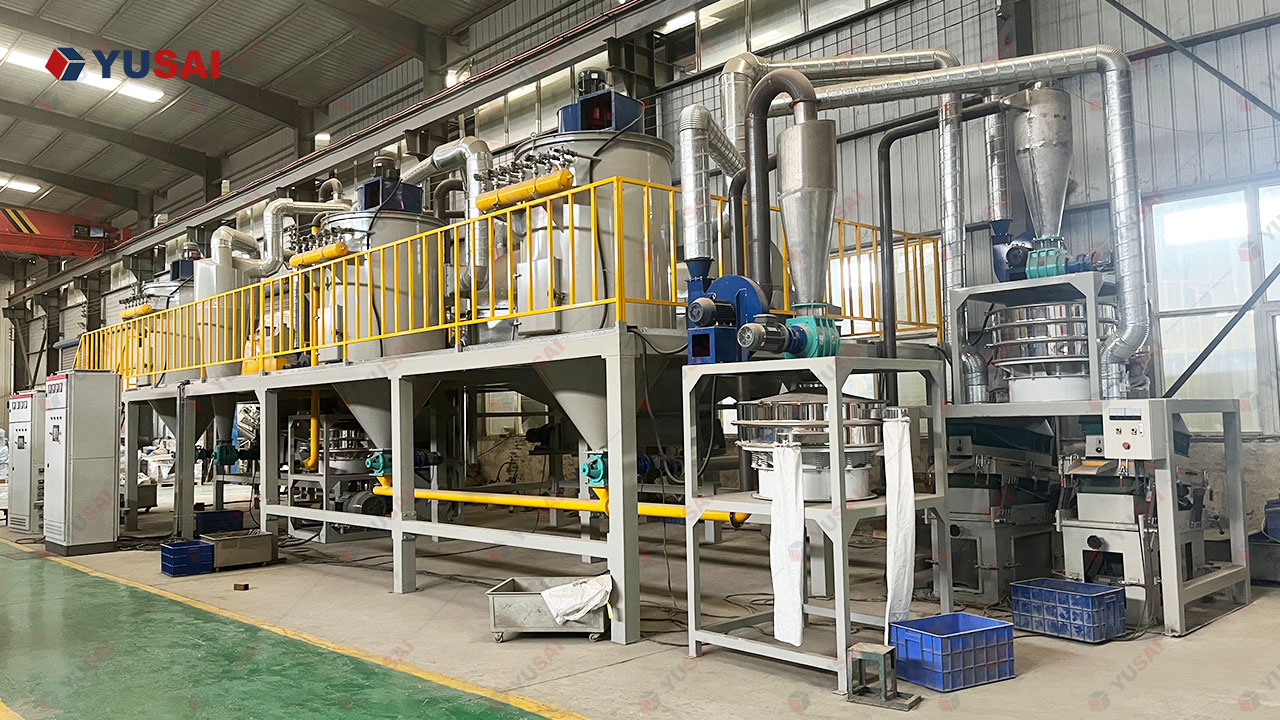
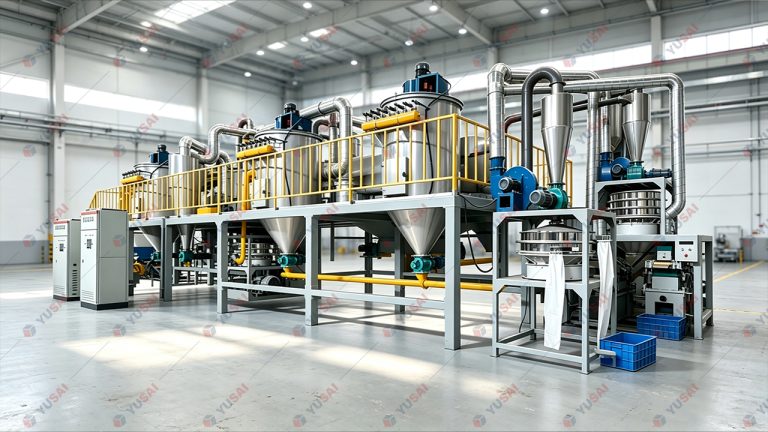
The Phase-1 line is a closed, fully automated train. Main equipment (benchmarked against the industry-standard 400–500 kg/h class line and upgraded with YuSai’s process design):
- Belt conveyor (anti-static PVC) — metered, sealed feeding; 400 mm flight spacing, anti-static belt.
- Inert-gas-protected crusher (single/double-shaft) — charged/discharge-free primary crushing under N₂ atmosphere with O₂ monitoring; shell disintegration to 3–5 cm.
- Electrolyte drying unit (screw conveyor with 100–200 °C heating) — hot volatilization of electrolyte at ~120 °C, nitrogen carrier ~300 m³/h; vapor to off-gas system.
- Hammer crusher (alloy steel + tungsten-carbide overlay) — breaks cathode/anode pieces to liberate metal from black mass.
- Sealed pneumatic conveying (wind conveyor) — fully enclosed negative-pressure transfer between stations.
- Linear screen (120 mesh) — primary classification, sealed dust-free.
- Diaphragm extraction box + collector — Z-structure airflow suction removes separator film (PP/PE).
- Circular vibrating screens (304 SS contact parts) — size classification, dual discharge.
- Magnetic separation belt (3500–5000 GS) — removes steel shells/iron at ~1 m³/h.
- Grinding machine (wear-resistant alloy discs) — mills electrode pieces (~20 mesh feed) to liberate fine powder; in-machine cooling keeps material < 50 °C.
- Trommel screen (rotary, self-cleaning) — high-efficiency screening of ground material.
- Air gravity separators (two-stage) — copper/aluminum separation by density; VFD airflow control.
- Pulse-jet dust collectors (3 units, 99.99% efficiency) — negative-pressure dust collection at crusher, screens and mills; filter area 90 m² each.
- PLC control cabinet — touch-screen central control; DCS/SCADA Ethernet interface reserved; 10% spare I/O.
- Off-gas treatment system (optional/Phase 2 add-on) — bag filtration → semi-dry defluorination → RTO regenerative combustion → denitrification → alkali spray.
Optional upgrades: battery-powder pyrolysis furnace (rotary kiln, 450–550 °C, oxygen-free, removes PVDF binder & raises black mass grade) · black-mass washing & water-recycle unit (friction washing of shells/diaphragm, settling + full water reuse) · high-speed liberation machine (negative foil → ~0.2 mm copper granules, positive foil → ~0.5 mm aluminum granules, active coating → < 50 µm battery powder).
Phase 2 (hydrometallurgy) main units: selective/acid-roasting leaching reactors · filter press · neutralization & impurity-removal tanks · bipolar-membrane electrodialysis (BPED) stack · MVR evaporator & crystallizer · solvent-extraction battery (P204 / P507 / C272) · cyclone electrodeposition cells (cathode copper) · off-gas scrubbers.
Process Flow
Phase 1 — Pretreatment & physical separation (8 steps):
Feed → Inert crushing → Electrolyte drying → Screening & diaphragm removal → Magnetic separation → Grinding → Air-gravity Cu/Al separation → Black mass collection (dust & off-gas treated throughout)
- Sorting & feeding. Cells are sorted by shell type and chemistry (LFP vs ternary/3C lines run in parallel for optimized parameters).
- Inert-gas-protected crushing (charged, discharge-free). The crusher operates under a nitrogen atmosphere (target O₂ ≤ 2%) with vacuum/closed feeding, flame detection and interlock shutdown. Residual battery energy is released safely inside the furnace/pyrolysis stage and partly recovered as process heat — eliminating brine-discharge wastewater (saves ~80万 kWh electricity, 2,500 t wastewater per year vs brine discharging in our reference plant).
- Electrolyte drying. Crushed material (3–5 cm) is heated to ~120 °C in the sealed drying conveyor; electrolyte volatilizes into the closed off-gas system (nitrogen carrier ~300 m³/h).
- Screening & diaphragm separation. Linear + circular screens classify material; the diaphragm extraction box pulls out separator film (PP/PE) by airflow for separate sale.
- Magnetic separation. Belt magnet (3500–5000 GS) removes steel shells and ferrous fragments.
- Grinding & liberation. The mill liberates active material from foils; high-speed liberation (optional) aggregates negative foil into ~0.2 mm copper granules and positive foil into ~0.5 mm aluminum granules, with active coating reduced to < 50 µm battery powder.
- Air-gravity separation (two-stage). Density separation splits copper and aluminum granules; final black mass is collected at 120–150 mesh.
- Product collection & environmental chain. Black mass, copper, aluminum, steel shells and diaphragm film are collected and bagged separately; pulse dust collectors (99.99%) keep the whole line under negative pressure.
Optional — battery-powder pyrolysis: black mass is treated in the rotary kiln at 450–550 °C for 0.5–2 h under non-oxidizing atmosphere to decompose residual electrolyte organics and PVDF binder, raising black mass grade. Off-gas joins the treatment chain (bag filter → semi-dry defluorination → RTO → denitrification → alkali spray), with emissions far below EU/Chinese limits (measured: particulates 4.5 mg/m³, VOCs 55.8 mg/m³, HF 1.7 mg/m³ — vs 10 / 80 / 1.7 mg/m³ limits).
Phase 2 — Hydrometallurgical refining (YuSai's differentiating technology):
- Lithium-first extraction: LFP powder undergoes selective oxidative leaching (H₂SO₄ + O₂/H₂O₂, ~3.5 h) — lithium dissolves while FePO₄ stays in residue; ternary powder is acid-roasted (350 °C, 0.5–1 h) then water-leached at ambient temperature (> 95% lithium sulfate recovered in one step). Lithium recovery 90–95% vs 50–70% in conventional back-end routes.
- Battery-grade LiOH without carbonate intermediate: purified lithium sulfate feeds a bipolar-membrane electrodialysis (BPED) system producing LiOH solution + H₂SO₄ (recycled to leaching); evaporation-crystallization yields battery-grade LiOH·H₂O. No sodium-salt by-product, no carbonate step.
- Ni/Co/Mn recovery: the leach residue enters two-stage countercurrent reduction acid leaching (60–90 °C) → copper removal (Lix984 extraction + cyclone electrodeposition → cathode copper) → impurity removal → P204/P507/C272 multi-stage solvent extraction separating Mn, Ni and Co → MVR evaporation-crystallization producing battery-grade NiSO₄·6H₂O, CoSO₄·7H₂O and MnSO₄·H₂O (ammonia-based saponification with closed-loop ammonia regeneration — no sodium sulfate by-product, ~¥12M/year saving vs sodium route).
- Zero-discharge design: wastewater and reagents circulate; alkaline scrubber liquor is regenerated with Ca(OH)₂; all emissions measured well below standards.
Product Features
- Charged, discharge-free crushing (patented process know-how) — no brine discharge, no discharge time, no discharge wastewater; inert-gas protection (O₂ ≤ 2%), sealed feeding, flame detection and interlock shutdown make it safe. Residual battery energy is released and partly reused — a genuine differentiator vs “discharge first” competitors.
- 98%+ recovery across fractions — black mass ≥ 98%, copper ≥ 96%, aluminum ≥ 95%, diaphragm ≥ 98% (vendor-verified range); black mass Cu+Al residue ≤ 1%.
- Two-stage electrolyte treatment — low-temperature drying (~120 °C) volatilizes electrolyte at the source, then optional oxygen-free pyrolysis (450–550 °C) strips PVDF binder for higher black mass grade — no open burning, no dioxin risk.
- Dry process with optional water-wash closed loop — water (when used for shell/diaphragm washing) is settled and fully reused; no process wastewater discharge.
- Clean-air engineering — pulse dust collectors (99.99%), RTO + semi-dry defluorination + denitrification + alkali spray treat fluorinated organics; measured emissions far below EU/Chinese limits.
- Phase 2 lifts margin dramatically — 95%+ lithium recovery (vs 50–70%), battery-grade LiOH·H₂O direct from BPED, battery-grade Ni/Co/Mn sulfates via extraction; reagent (ammonia, acid) closed-loop recycled.
- Modular & upgradeable — buy the Phase-1 line today, add pyrolysis, washing or the full hydrometallurgy phase later without replacing front-end equipment; components (shredder, black-mass section) can upgrade existing third-party lines.
- Fully automatic PLC / SCADA-ready — one-operator supervision, touch-screen control, reserved DCS Ethernet interface, 10% spare I/O, parameter storage and interlock protection.
- Custom engineering — capacity 300 kg/h to multi-t/h; pilot, mid and 50,000 t/a class plant design; layout, voltage and emission limits engineered per site.
- Turnkey delivery — factory trial run before shipment, installation & commissioning, operator training, 12-month warranty, lifetime support.
Technical Parameters
Phase 1 — Pretreatment & Physical Separation Line Parameters
| Model class | Capacity | Installed power | Footprint (L×W×H) |
|---|---|---|---|
| YS-LBR-500 | 400 – 500 kg/h | ~226 kW | 30 × 10 × 4.8 m |
| YS-LBR-1000 | 800 – 1,200 kg/h | ~350 – 450 kW | 40 × 15 × 6 m |
Model names are indicative; YuSai confirms the exact model code and specifications in the engineering proposal after free raw-material testing.
Phase 2 — Hydrometallurgical Refining Parameters
| Parameter | Value |
|---|---|
| Crushing size (primary) | 3 – 5 cm (inert atmosphere, O₂ ≤ 2%) |
| Electrolyte drying temperature | ~120 °C (nitrogen carrier ~300 m³/h) |
| Pyrolysis temperature (optional) | 450 – 550 °C, 0.5 – 2 h, oxygen-free |
| Screening mesh | 120 mesh (linear) + rotary trommel |
| Magnetic separator | 3500 – 5000 GS |
| Grinding output | ~20 mesh feed → fine powder; material < 50 °C in-machine |
| Liberation size (optional) | Cu granules ~0.2 mm, Al granules ~0.5 mm, powder < 50 µm |
| Black mass fineness | 120 – 150 mesh |
| Recovery (Phase 1) | Black mass ≥ 98%, Cu ≥ 96%, Al ≥ 95%, diaphragm ≥ 98%; Cu+Al in black mass ≤ 1% |
| Dust collection efficiency | 99.99% (pulse-jet) |
| Off-gas treatment | Bag filter → semi-dry defluorination → RTO → denitrification → alkali spray |
| Measured emissions | Particulates 4.5 / VOCs 55.8 / HF 1.7 / SO₂ 13.3 / NOₓ 40.1 mg/m³ (reference plant) |
| Control system | PLC + touch screen, O₂/temperature monitoring, interlock, DCS interface reserved |
| Operators | 1 – 2 per shift, fully automatic |
| Phase 2 hydrometallurgy | Li recovery > 90 – 95%; Ni/Co 95 – 98%; Mn 90 – 95%; products battery-grade LiOH·H₂O, NiSO₄·6H₂O, CoSO₄·7H₂O, MnSO₄·H₂O, cathode copper |
Advantages
- Real process engineering, not copied brochures — YuSai has delivered complete engineering for a 50,000 t/a green Li-ion battery recycling project (44,000 t/a batteries & scrap; outputs incl. 5,912 t/a battery-grade LiOH, 7,810 t/a CoSO₄, plus NiSO₄/MnSO₄). Page claims are backed by plant-level design data.
- Precious-metal refining know-how applied to batteries — the same electrolysis, solvent-extraction (P204/P507/C272) and RTO off-gas technologies YuSai uses in gold/silver/PGM refining run in the battery hydrometallurgy phase. One engineering team, cross-validated chemistry.
- Charged crushing edge — discharge-free feed removes the industry’s #1 bottleneck (brine discharge cost, incomplete discharge risk, labor) while inert-gas safety meets the strictest EU/US expectations.
- 95%+ lithium recovery & battery-grade LiOH direct — no lithium carbonate intermediate, no sodium sulfate by-product; economics validated (+¥63M/year upgrade margin in project studies).
- Free raw-material testing — send 5–10 kg of your actual scrap; we run the pilot line and return a test report (recovery rates, purity, output composition) before you commit.
- Full range under one roof — from single shredder upgrades to complete lines, pyrolysis furnaces, hydrometallurgy plants and downstream refining equipment; one vendor, one responsibility chain, no interface disputes.
- Compliance-ready — CE/ISO documentation, EIA/permit guidance, and process design aligned with EU Battery Regulation 2023/1542 recovery targets (65%→70% efficiency, Li 50%→80%, battery passport) so your plant is future-proof.
- Factory trial run & documentation — full-load test with video report before shipment; drawings, operation/maintenance manuals included.
- Global delivery & responsive support — [Replace with delivered project cases: country, capacity, year]; 24/7 online support, spare parts at cost, lifetime consultation.
Quality System
YuSai operates a full-process quality management system across design, fabrication, assembly, testing and after-sales:
- Design phase — every line is engineered from the customer’s raw-material test report; process calculations (capacity, power, O₂ control, emissions) are reviewed and locked before manufacturing. Pilot-plant data (50,000 t/a project design basis) informs scale-up.
- Material & fabrication — incoming steel and electrical components inspected; certified welders with weld-seam records; anti-corrosion treatment on all process equipment; wear parts (crusher hammers, mill discs) in alloy steel with tungsten-carbide overlays.
- Assembly & electrical — CE-compliant cabinets (CE documentation on request), color-coded wiring, protective earthing, safety interlocks; PLC with 10% spare I/O and DCS interface.
- Factory trial run — no-load test, load test with representative material, recovery/purity sampling, 24 h continuous run for new configurations; video report and test certificate accompany delivery.
- Documentation — operation manual, maintenance manual, layout/installation drawings, electrical diagrams, spare-parts list, CE declaration and export compliance documents where required.
- Continuous improvement — field feedback feeds design updates; control-software and process upgrades offered to installed lines (lifetime upgrade support).
Service Process
- Consultation & requirement analysis — raw-material type & daily tonnage, target outputs (black mass only, or battery-grade chemicals), budget, site conditions and local regulations.
- Free raw-material test — 5–10 kg sample run on the pilot line; test report with recovery rates, purity and output composition.
- Solution design & quotation — process design, plant layout, equipment list and commercial quotation with delivery schedule.
- Manufacturing — fabrication in our own factory with scheduled progress updates (photos/videos) and stage inspections.
- Factory trial run — full-line assembly and load test before shipment; video report provided.
- Shipping & logistics — sea/air freight, container loading supervision, customs/export documentation (incl. UN38.3/battery transport guidance where relevant).
- Installation & commissioning — engineers on site (or remote guidance), electrical connection and safety checks.
- Operator training — hands-on training for operators and maintenance staff: operation, adjustment, safety procedures (charged-crushing envelope, inert-gas discipline), routine maintenance.
- After-sales — 12-month warranty, spare parts at cost, 24/7 online support, lifetime process consultation.
Warranty & After-Sales Service
- 12-month warranty on the complete line against manufacturing defects (consumables/wear parts excluded per contract).
- Spare parts at cost price for machine lifetime; recommended spare-parts list supplied.
- 24/7 online support — WhatsApp/WeChat/email with remote video diagnosis; most issues resolved within 24 h.
- Lifetime technical consultation — process optimization, output tuning, free control-software upgrades.
- Documentation package — manuals, drawings, electrical diagrams, video training files (English; local language on request).
- Compliance support — EIA/permit application assistance; CE/ISO documentation; guidance on EU Battery Regulation reporting (recycling efficiency, material recovery, battery passport data chain).
- On-site service — engineers dispatched for major maintenance/expansion; service agreements for large plants.
Precautions (Operation & Safety Notes)
- Validated feed envelope (critical) — “discharge-free/charged crushing” applies only within the validated envelope: cell type & size, maximum state of charge (SOC), damage state and feed rate as defined in the engineering proposal. Batteries outside the envelope (e.g., damaged, swollen, or high-SOC packs beyond limits) must be pre-discharged or pre-dismantled. Laboratory results are not commercial guarantees.
- Inert-gas discipline — crushing and pyrolysis stages require a reliable N₂ supply (generator, liquid tank or cylinders); O₂ monitors must read ≤ 2% during operation. Never run the crusher without the inert atmosphere engaged.
- Feedstock screening — exclude foreign objects and non-Li-ion chemistries (lead-acid, NiMH). Leaking, swollen or damaged cells handled separately with extra caution.
- Whole-pack EV processing — large EV packs usually require module-level dismantling first (remove shell, busbars, connectors, cooling and electronics) unless within the validated pack envelope.
- Dust & black mass handling — black mass is fine, conductive and potentially reactive; store sealed and dry, away from ignition sources and moisture; comply with local rules for transport/export.
- Fluorinated off-gas — electrolyte vapors contain fluorine; the treatment chain (defluorination → RTO → denitrification → alkali spray) must run whenever the line runs; monitor scrubber levels and activated carbon.
- Operator training & PPE — trained operators only; goggles, gloves, anti-static clothing, respiratory protection; fire detection/suppression near crusher and dust collectors.
- Routine maintenance — shredder blades/hammers, screens, filter bags, seals, O₂/temperature sensors per schedule; keep spare parts in stock.
- Electrical safety — qualified electricians only; lock-out/tag-out before maintenance; proper earthing.
- Regulatory compliance — verify waste import/export rules, EPR registration, environmental permits and (for EU sales) Battery Regulation 2023/1542 obligations before commissioning; YuSai provides guidance documents.
FAQ (Frequently Asked Questions)
Q1. What types of batteries can this plant process?
A: All common Li-ion formats — pouch, cylindrical (18650/21700/32650) and prismatic — and chemistries NCM/NCA, LFP, LMO, LCO, from EV packs, e-bikes, consumer electronics and ESS, plus cell production scrap and coated-foil offcuts. Lead-acid and NiMH need dedicated lines (YuSai supplies them too).
Q2. Do batteries need to be discharged before processing?
A: With our charged (discharge-free) crushing technology, cells within the validated feed envelope can be processed without brine discharging — no discharge wastewater, no incomplete-discharge risk. Batteries outside the envelope (damaged/swollen, very high SOC, oversized packs) are pre-discharged or pre-dismantled first. If you prefer the conservative route, we also offer a discharging unit.
Q3. What is the recovery rate?
A: Reported by stage: Phase 1 black mass ≥ 98%, copper ≥ 96%, aluminum ≥ 95%, diaphragm ≥ 98%, with Cu+Al in black mass ≤ 1%. Phase 2 hydrometallurgy: Ni/Co 95–98%, Mn 90–95%, lithium > 90–95% with our lithium-first route (industry back-end routes typically 50–70%). All claims verified by free raw-material testing.
Q4. What is the purity of the black mass / final chemicals?
A: Black mass 120–150 mesh with ≤ 1% Cu+Al residue. With Phase 2, products are battery-grade: LiOH·H₂O, NiSO₄·6H₂O, CoSO₄·7H₂O, MnSO₄·H₂O — meeting lithium-battery supply-chain specifications.
Q5. How much space is needed?
A: A 400–500 kg/h line is about 30 × 10 × 4.8 m (L×W×H); 1,000 kg/h class about 40 × 15 × 6 m; 2,000 kg/h about 55 × 18 × 6.5 m — plus material storage and, for Phase 2, a hydrometallurgy building. We provide a site layout drawing customized to your plot (see also our plant layout guide on request).
Q6. Can I start with a small line and expand later?
A: Yes — modular by design. Start with Phase 1 (300 kg/h pilot up), add pyrolysis, washing, or the full Phase 2 hydrometallurgy plant later without replacing front-end equipment. Existing third-party lines can also be upgraded with our shredders or black-mass section.
Q7. Can whole EV battery packs be crushed directly?
A: Only within the validated envelope (pack/module size, SOC, damage state). In most cases we recommend module-level dismantling first — remove shell, busbars, connectors and cooling components — which also improves product purity. We can supply the dismantling workstations.
Q8. Does the plant meet EU Battery Regulation 2023/1542 and environmental requirements?
A: Yes by design: the process targets the regulation’s recovery milestones (65%→70% Li-ion recycling efficiency; Li 50%→80%, Co/Ni/Cu 90%→95% material recovery; battery passport data chain from Feb 2027). Emissions are measured far below limits (particulates 4.5, VOCs 55.8, HF 1.7 mg/m³ at reference plant); CE/ISO documentation and EIA guidance provided.
Q9. What is the delivery time?
A: Standard Phase-1 lines are manufactured in about 40–50 working days after order confirmation, plus shipping; custom and Phase-2 plants per engineering schedule. Confirmed in the quotation.
Q10. How much does a lithium battery recycling plant cost?
A: It depends on capacity and configuration: The market price range for a complete physical production line is approximately US$75,000 to US$350,000. hydrometallurgy phase quoted separately. Send us your material and capacity for an itemized quotation with ROI analysis.
Q11. Can I buy only parts of the line to upgrade my existing recycling setup?
A: Yes — shredders, crushers, black-mass separation sections, dust collectors and PLC systems are sold separately to upgrade third-party lines. Tell us your current equipment and target output.
Q12. Does the plant handle LFP and NMC mixed feed?
A: The Phase-1 line processes both (parallel lines or adjustable crushing parameters); for Phase 2, LFP and ternary streams follow different lithium-first routes, so we recommend segregated feedstock for maximum battery-grade product quality — we design the sorting stage accordingly.

Get A Free Quote
Fill in the form below and our service team will get back to you within 24 hours with a recommended process flow and quotation.
- +86 18339216321
- info@yusaipreciousmetals.com
- Zhengzhou.Henan.China
If you be interested in our equipment and solutions, please to contact us.
- +86 18339216321
- info@yusaipreciousmetals.com
- zhengzhou.henan.china