
Lithium-Ion Battery Pyrolysis Recycling Plant
— Turnkey Lithium-Ion Battery Pyrolysis Recycling Plant
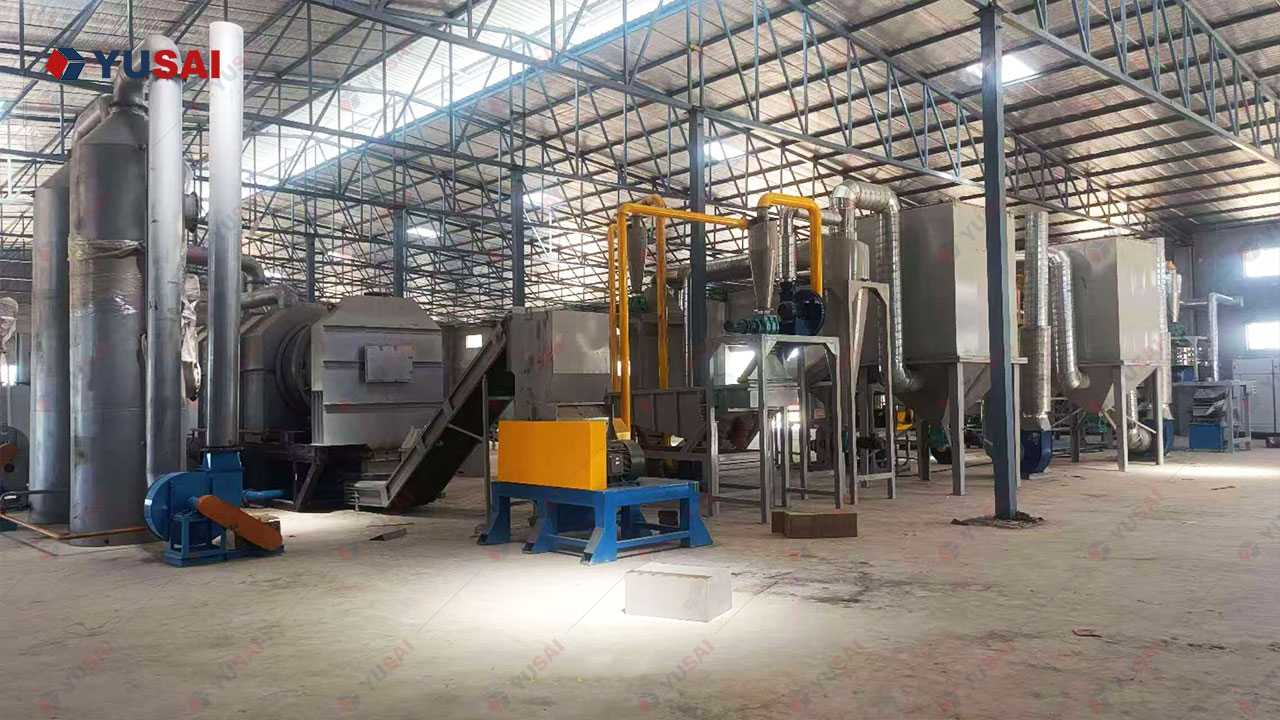
The lithium-ion battery pyrolysis recycling plant is a complete, turnkey production line that turns spent and defective lithium-ion batteries into saleable materials. Inside the lithium battery pyrolysis furnace — a gas-fired rotary kiln operating at 450–550 °C in an oxygen-free atmosphere — electrolytes, PVDF binders and separator organics decompose into gas, releasing the valuable electrode coating from the copper and aluminum current-collector foils. A downstream multi-stage physical separation system then recovers black mass (rich in lithium, cobalt, nickel and manganese) at ≥98% purity, together with copper granules, aluminum granules and steel shells, ready for direct sale to hydrometallurgical refineries or cathode material producers.
Product Overview
Global end-of-life lithium-ion batteries are growing exponentially with the electrification of mobility and energy storage. Industry data indicates the global lithium battery recycling market will exceed USD 10 billion by 2030, with China accounting for more than half; by 2025, China’s ternary and LFP waste recycling volume alone is projected to reach 176,000 tonnes (LFP 52.27%, ternary 41.48%). Meanwhile EU regulations are standardizing black mass trade, and China’s “Dual Whitelist” licensing system is consolidating the industry around certified recyclers — all of which favors professionally equipped recycling plants.
Purely mechanical recycling cannot handle the flammable electrolyte and PVDF binder inside spent cells: crushing an unprocessed battery is a fire and explosion risk, and mechanical-only separation leaves electrode powder locked to the foils, lowering black mass purity and metal recovery. Pyrolysis solves both problems: thermal decomposition in an oxygen-free rotary kiln converts electrolyte and binder into gas (safely incinerated and scrubbed), while inorganic electrode materials (Li, Co, Ni, Mn, graphite) detach cleanly from the foils. This “pyrolysis + physical sorting” combination is today’s mainstream pre-treatment for industrial-scale battery recycling and the ideal front-end for hydrometallurgical black mass refining, in which YuSai’s partner plants achieve ≥90% lithium recovery via priority lithium extraction and bipolar-membrane electrodialysis.
What you receive with a YuSai turnkey plant:
- Complete process design and plant layout tailored to your raw material mix, target capacity and local emission regulations;
- All major equipment: charged-crushing or discharge system, drying unit, pyrolysis furnace, sorting and separation machinery, fluorine off-gas treatment, nitrogen protection and PLC control;
- Site installation, commissioning and operator training by YuSai engineers;
- One-year warranty, lifetime spare parts supply and remote technical support.
Recycling Value Analysis
Understand exactly what is inside a spent lithium-ion battery — and what each tonne can return to you.
1. Metal composition of lithium battery black mass
The economic heart of battery recycling is the cathode material. Representative metal content based on European black mass samples and Chinese recycling process data:
- Cobalt (Co): ~15.79% in ternary batteries such as NCM811; <0.5% in LFP (lithium iron phosphate) black mass.
- Nickel (Ni): 6.94% – 20% in ternary black mass (over 60% in high-nickel systems like NCM811).
- Lithium (Li): ~3.19% in LFP black mass; 2.5% – 4% in ternary black mass.
- Copper (Cu) & Aluminum (Al): Cu 1.97% – 5%, Al ~5.13%, from current collectors and structural components.
- Manganese (Mn): ~4.82%, plus fluorine and impurities that require wet-process purification downstream.
Source: YuSai market analysis report on lithium battery black mass extraction (China Nonferrous Metals Industry Association, SMM Lithium Battery Recycling Report, EU Circular Economy Act data, 2025). Actual composition depends on cell chemistry, brand and feed condition. Free laboratory analysis of your sample is offered before project design.
2. Indicative cost and profit structure (per tonne of spent batteries)
- LFP batteries: recycling cost ~USD 1,190 (CNY 8,500) vs. regenerated value ~USD 1,260 (CNY 9,000) — gross margin 5% – 10%. Cost drivers: disassembly (~CNY 2,000), wet-process lithium extraction (~CNY 3,000), environmental compliance (~CNY 1,500).
- Ternary (NMC) batteries: recycling cost ~USD 3,500 (CNY 25,000), with cobalt/nickel extraction (~48%), lithium extraction (~32%) and environmental compliance as the main cost centers; regenerated value is substantially higher, driven by cobalt and nickel content (cobalt sulfate prices surged over 60% in H2 2025).
- Second-life option: batteries retaining >80% capacity can be redirected to echelon use in low-speed vehicles and energy storage, reducing overall recycling cost by ~30%.
3. Value streams your plant monetizes
- Black mass sales: the highest-value output, sold to hydrometallurgical refiners or CAM (cathode active material) producers for conversion into battery-grade lithium hydroxide/carbonate, nickel sulfate, cobalt sulfate and manganese sulfate.
- Copper and aluminum granules: clean, saleable non-ferrous scrap with stable market prices.
- Steel/iron shells and separator film: additional income from battery casings and PP/PE separators.
- Integrated refining option: for larger projects, YuSai can extend the line into a complete hydrometallurgical plant — a 50,000 t/a reference design produces battery-grade nickel sulfate (1,542 t/a), cobalt sulfate (7,810 t/a), manganese sulfate (3,264 t/a) and lithium hydroxide (5,912 t/a), plus shells (4,420 t/a), copper (2,988 t/a) and aluminum (2,150 t/a).
Applicable Materials
Battery formats
- Cylindrical cells: 18650, 21700, 26650, 32650
- Soft-pouch / polymer cells (Li-polymer)
- Prismatic hard-shell cells: aluminum-case and steel-case
- Complete battery packs and modules (EV, e-bike, ESS) after dismantling
- Consumer electronics batteries: mobile phone, laptop, power bank
- Production scrap: off-spec cells, cathode/anode electrode offcuts
Battery chemistries
- Ternary: NMC (LiNiₓCoₓMnₓO₂) and NCA (LiNiₓCoₓAlₓO₂)
- LFP — lithium iron phosphate (LiFePO₄)
- LCO — lithium cobalt oxide (LiCoO₂)
- LMO — lithium manganese oxide (LiMn₂O₄)
- Mixed / sorted streams combining several chemistries
Because pyrolysis only decomposes the organic electrolyte and binder, the same line processes mixed chemistries without reconfiguration. In the 50,000 t/a reference design, LFP and ternary (including 3C) cells are split into two parallel pre-treatment lines, each tuned to its feed — a proven layout we replicate at any scale. One set of crushing equipment handles cylindrical, prismatic and pouch formats simultaneously.
Product Structure (Main Equipment)
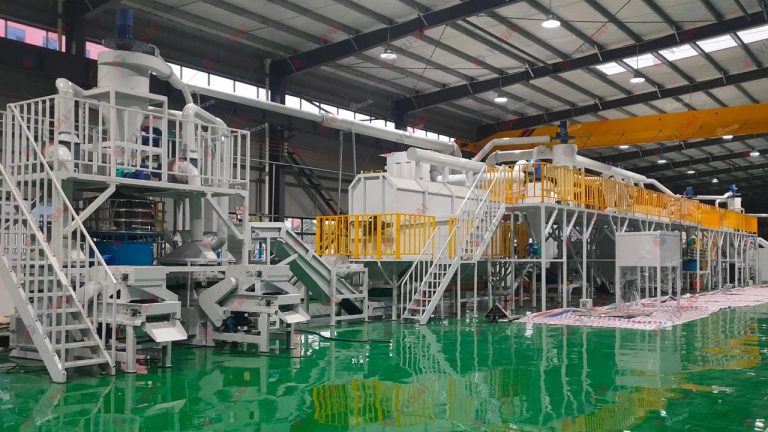
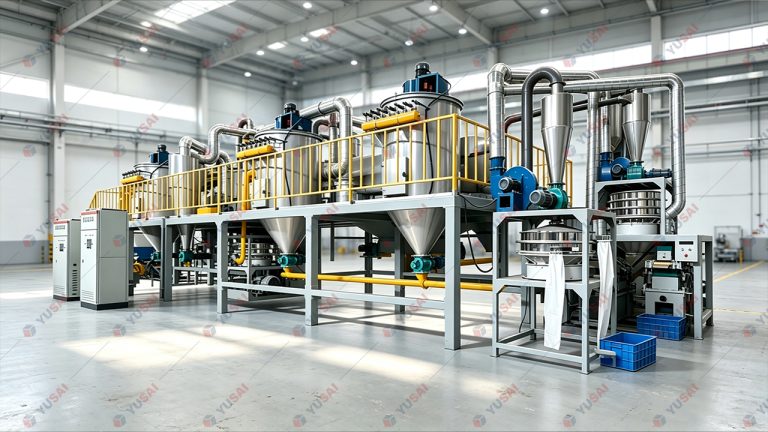
A complete lithium-ion battery pyrolysis recycling plant consists of nine integrated modules:
- Feeding & Crushing System — Choose conventional deep-discharge chambers or YuSai’s charged-crushing module: sealed, vacuum-fed single-shaft crusher under nitrogen protection that breaks cells into 3–5 cm fragments without prior discharging.
- Electrolyte Drying Unit — Electrically heated drying system that vaporizes electrolyte at ~120 °C under a nitrogen sweep (300 m³/h class), with fully enclosed fume extraction to the gas treatment train.
- Rotary Kiln Pyrolysis Furnace — Gas-fired external-heat rotary kiln (natural gas) running at 450–550 °C for 0.5–2 h in a non-oxidizing atmosphere, decomposing high-boiling-point electrolytes and PVDF into organics, HF and CO₂ while retaining all metal values.
- High-Speed Decomposing & Friction Separator — Decomposes electrode sheets: negative plates friction-agglomerate into ~0.2 mm copper granules, positive plates into ~0.5 mm aluminum granules, and active coatings separate into battery powder finer than 50 µm.
- Gravity & Magnetic Separation — Shell sorting by specific-gravity differences, followed by magnetic separation to recover steel/iron casing; heavy and light fractions are split for downstream screening.
- Rotary Drum Screen + Fine Crusher — Rotary screen sifts out fine black mass; oversize fraction passes through a noise-proofed crusher that breaks electrode pieces and knocks off residual coating.
- Air Classification System — Precision air classifier (with cyclone and pulse dust collection) that separates copper granules from aluminum granules and recovers floating black dust.
- Fluorine Off-Gas Treatment Train — “Bag dust collection + semi-dry defluorination + RTO (regenerative thermal oxidation) + denitrification + alkali scrubbing” — the low-cost, low-wastewater solution developed for fluorine-bearing battery off-gas.
- Nitrogen Protection & PLC Control — Automated N₂ inerting keeps oxygen below the safety threshold in all crushing and conveying stages; PLC manages the entire line with interlocks, gas detection and data logging.
Working Process
From a spent battery at the gate to saleable black mass, copper and aluminum at the other end — nine controlled stages.
- Classification & Sorting — Batteries are sorted by chemistry (LFP vs. ternary/3C) and format; each stream feeds its own pre-treatment line for optimal recovery.
- Discharging or Charged Crushing — Conventional route: deep discharge removes residual energy. Advanced route: cells enter a sealed, vacuum-fed crusher under nitrogen inerting — residual energy is later released safely in the pyrolysis furnace and recovered as heat, with no discharge wastewater.
- Nitrogen-Shielded Crushing — Cells are broken into 3–5 cm fragments under inert-gas protection and forced-disturbance design; casing, anode, cathode and separator are liberated.
- Electrolyte Drying — Fragments pass through the electrically heated drying unit (~120 °C, nitrogen sweep), removing most electrolyte vapor before sorting; all vapors are captured under negative pressure.
- High-Temperature Pyrolysis — Dried fragments are conveyed into the rotary kiln, where residual electrolyte and PVDF decompose at 450–550 °C for 0.5–2 h in a non-oxidizing atmosphere, producing organics, HF and CO₂; off-gas enters the fluorine treatment train.
- Physical Separation & Shell Sorting — Pyrolyzed material is separated by specific gravity into shells/diaphragm and electrode scrap; magnetic separator recovers ferrous casings.
- High-Speed Decomposition & Screening — Electrode sheets are decomposed and friction-separated into copper granules (~0.2 mm), aluminum granules (~0.5 mm) and battery powder (<50 µm); rotary screening isolates fine black mass from oversize.
- Air Classification & Metal Recovery — Copper and aluminum granules are separated with high precision; floating black dust is captured by cyclone and returned to the black mass stream.
- Off-Gas Treatment & Discharge — All fluorine-bearing organic off-gas passes through bag filtration, semi-dry defluorination, RTO combustion, denitrification and alkali scrubbing; treated flue gas is emitted well below regulatory limits, with wastewater minimized and recycled.
Product Features
- Advanced Charged-Crushing Technology — Vacuum feeding + inert-gas-protected crushing eliminates the discharge step, avoids brine-discharge wastewater, and reuses residual cell energy inside the pyrolysis furnace — a genuinely green and safe pre-treatment.
- Industrial-Grade Safety — Nitrogen inerting, sealed negative-pressure operation, gas detection and PLC interlocks fundamentally eliminate combustion and explosion risk from residual charge and flammable vapors.
- Fluorine-Aware Emission Control — Bag filtration + semi-dry defluorination + RTO + denitrification + alkali scrubbing handles HF-bearing off-gas at low cost with minimal wastewater — the proven design from a 50,000 t/a project.
- Fully Automated — PLC-based automatic monitoring and control reduce manual intervention, stabilize product quality and lower labor cost; data logging supports environmental reporting.
- Universal Compatibility — One crushing system handles cylindrical, pouch and prismatic cells across NMC, NCA, LFP, LCO and LMO — no reconfiguration when the feed mix changes.
- 24/7 Continuous Operation — Designed for round-the-clock industrial production from 500 kg/h pilot lines to 50,000 t/a plants; pyrolysis waste heat can be recovered to offset plant energy use.
Technical Parameters
| Parameter | YS-LBP-500 | YS-LBP-1000 | YS-LBP-1500 | YS-LBP-2000 |
|---|---|---|---|---|
| Processing capacity | 500 – 800 kg/h | 800 – 1,000 kg/h | 1,200 – 1,500 kg/h | 1,500 – 2,000 kg/h |
| Annual capacity equivalent | ~10,000 t/a | ~20,000 t/a | ~30,000 t/a | ~50,000 t/a |
| Pyrolysis furnace | Gas-fired external-heat rotary kiln, 450–550 °C, retention 0.5–2 h, PLC controlled | |||
| Pre-treatment mode | Charged crushing (N₂-inerted, vacuum-fed) or conventional deep discharge — customer option | |||
| Total installed power | ~250 kW | ~380 kW | ~480 kW | ~530 kW |
| Working voltage | 380 V ± 10% (415 V / 440 V / custom available) | |||
| Plant footprint (L×W×H) | 35×12×6 m | 45×12×6 m | 50×8×6 m | 60×8×6 m |
| Total weight | ~22 t | ~28 t | ~40 t | ~55 t |
| Operation mode | Continuous, 24 h/day, PLC automatic with manual override | |||
| Black mass purity | ≥ 98% (Cu/Al content in black mass ≤ 1%) | |||
| Copper / Aluminum recovery | ≥ 98% (copper granules ~0.2 mm, aluminum granules ~0.5 mm) | |||
| Steel shell recovery | ≥ 99% | |||
| Nitrogen protection | Automated N₂ inerting, O₂ level monitored below safety threshold during crushing | |||
| Off-gas treatment | Bag dust collection + semi-dry defluorination + RTO combustion + denitrification + alkali scrubbing |
Note: Parameters and configurations above are for reference only. YuSai Machinery provides customized solutions and related battery recycling machines based on your raw material analysis, capacity target and local environmental regulations. Contact us to discuss your specific requirements.
Advantages of Choosing YuSai Machinery
- One-stop turnkey supply — Process design, equipment manufacturing, installation, commissioning and training under a single contract — no interface risk between suppliers.
- 50,000 t/a project track record — Our reference design integrates the full “crushing & separation + pyrolysis + wet smelting” chain, with battery-grade outputs of nickel sulfate, cobalt sulfate, manganese sulfate and lithium hydroxide — evidence of real industrial capability, not just drawings.
- Green, low-waste process — Charged crushing avoids discharge wastewater; priority lithium extraction raises lithium recovery from the industry’s 50–70% to ≥90%; fluorinated off-gas is treated without dumping pollutants into water.
- Higher recovery economics — ≥98% black mass purity and ≥98% Cu/Al recovery translate directly into higher sales value per tonne of feed than mechanical-only shredding lines.
- Safety-first engineering — Nitrogen inerting, sealed negative pressure and PLC interlocks are standard on every line, protecting your people and your investment.
- Emission compliance — Measured main-stack concentrations (particulates 4.47 mg/m³, VOCs 55.8 mg/m³, HF 1.70 mg/m³, SO₂ 13.3 mg/m³, NOₓ 40.1 mg/m³) are far below Chinese and international limits; documentation supports permits and sustainability reporting.
- Tailored design — We size the plant to your feed volume, battery mix and final product targets, and provide a free return-on-investment analysis before you commit.
- Lifetime technical support — One-year warranty, spare parts inventory, remote diagnostics and on-site service — our engineers stay with you after commissioning.
Quality System & Certifications
- Certified management — ISO 9001 quality management system covering design, manufacturing, inspection and after-sales service; CE certification available per order.
- Materials & fabrication — Kiln shells and pressure parts are fabricated from certified carbon steel and stainless steel with documented material certificates; refractory linings are selected for thermal cycling resistance.
- Manufacturing control — Each weld is inspected, every rotating assembly is dynamically balanced, and each module undergoes a factory acceptance test (FAT) before shipment.
- Electrical & control — PLC cabinets are wired to IEC standards with overload, short-circuit and emergency-stop protection; explosion-proof electrical components are used in classified zones; full electrical documentation is delivered with the machine.
- Environmental verification — Off-gas treatment performance is validated by third-party stack testing on reference projects, with measured concentrations documented for permit applications.
- Documentation package — Each shipment includes drawings, operation & maintenance manual, spare parts list, and CE/ISO certificates as required.
Service Process
A transparent, structured journey from first inquiry to a running recycling plant.
- Inquiry & Consultation — Share your raw material (battery type, volume per day) and target products. We reply within 24 hours with a preliminary solution.
- Sample Testing & Solution Design — Send us a sample or test data; our engineers run feasibility analysis, sizing and a customized plant layout with an ROI estimate.
- Quotation & Contract — Formal quotation with technical specifications, delivery terms and warranty; contract and payment schedule confirmed.
- Manufacturing & Factory Acceptance Test — Production in our workshop with progress photos/videos; FAT conducted before shipment to verify every module.
- Shipping & Logistics — Safe packing and shipping by sea/air with full documentation; we coordinate customs and delivery to your site.
- Installation & Commissioning — YuSai engineers supervise installation, commission the line, and run trial production until output meets specification.
- Training & Handover — Operator and maintenance training, operating manuals and complete handover documents.
- After-Sales Support — Warranty service, remote diagnostics, spare parts supply and optional annual maintenance visits for the life of the plant.
Warranty & After-Sales Service
- Standard warranty — 12 months from commissioning, covering defects in materials and workmanship (excluding consumables and damage caused by misuse).
- Spare parts — A recommended spare parts list is supplied with each plant; critical spares (kiln internals, crusher blades, filter bags, sensors) are kept in stock for fast dispatch worldwide.
- Remote support — Free remote troubleshooting via video call, with response within 24 hours for any operational issue.
- On-site service — Our engineers are available for on-site repair, preventive maintenance and line upgrades; service visits are quoted transparently.
- Technical upgrades — Customers receive notices of process improvements and optional upgrades (e.g., priority lithium extraction module, higher-efficiency separators, enhanced gas treatment) at preferred pricing.
- Training — Free operator training at commissioning; additional training for new operators available on request.
Important Notes & Precautions
Safe and efficient operation of a lithium battery recycling plant requires strict adherence to the following points.
- Crushing safety first — Whether you choose charged crushing or conventional discharging, the nitrogen inerting supply must never be interrupted during crushing; monitor the oxygen analyzer and pause the line if O₂ exceeds the safe threshold.
- Segregate swollen / thermal-runaway cells — Visibly damaged, swollen or leaking cells must be separated and handled per your safety protocol before entering the line.
- Ventilation & gas detection — Keep the plant hall ventilated and install combustible gas and HF/fluoride detectors where required by local regulation.
- Personal protective equipment (PPE) — Operators must wear flame-resistant clothing, safety glasses, gloves and respiratory protection per the operation manual, especially near the kiln and gas treatment units.
- Firefighting readiness — Maintain dry powder / CO₂ extinguishers and water supply at designated points; never use water on energized battery fires.
- Off-gas system integrity — The defluorination and RTO units must be operated and maintained per schedule — bypassing them risks HF emission and permit violations.
- Wastewater & residues — Process water and solid residues must be disposed of in accordance with local environmental regulations; alkali scrubbing liquor is treated and recycled in the closed-loop design.
- Qualified operators only — Only trained personnel may operate the PLC and furnace systems; keep the operation log daily.
FAQ (Frequently Asked Questions)
Q1. What is a lithium battery pyrolysis recycling plant?
A complete production line that treats spent lithium-ion batteries using oxygen-free rotary-kiln pyrolysis (450–550 °C) to decompose electrolytes and PVDF binders, then multi-stage physical sorting to recover black mass, copper, aluminum and steel at high purity.
Q2. Why is pyrolysis necessary in lithium battery recycling?
Pyrolysis removes the flammable electrolyte and PVDF binder, eliminating fire risk in downstream crushing, releasing electrode coatings from the foils, and significantly improving black mass purity and metal recovery compared with mechanical-only shredding. It is the industry-standard pre-treatment before hydrometallurgical refining.
Q3. Which battery types can the plant process?
Cylindrical (18650, 21700, 26650), pouch and prismatic cells in NMC/NCA, LFP, LCO and LMO chemistries, including mixed consumer batteries, production scrap and dismantled EV battery packs — no line reconfiguration needed.
Q4. Do batteries need to be discharged before crushing?
Not necessarily. YuSai offers two routes: conventional deep discharge, or advanced charged crushing under inert-gas protection with vacuum feeding — no brine discharge, no wastewater, and residual cell energy is recovered inside the pyrolysis furnace.
Q5. What final products will I get?
Black mass ≥98% purity (rich in Li, Co, Ni, Mn — ready for refining into battery-grade lithium hydroxide/carbonate, nickel sulfate, cobalt sulfate and manganese sulfate), copper granules ≥98%, aluminum granules ≥98%, and steel shells ≥99%, all directly saleable.
Q6. How is fluorine-containing off-gas treated?
Fluorine-bearing organic off-gas is treated through bag dust collection, semi-dry defluorination, RTO (regenerative thermal oxidation), denitrification and alkali scrubbing. Reference-project stack measurements show emissions far below regulatory limits, with wastewater minimized.
Q7. How profitable is a lithium battery recycling plant?
For LFP batteries, typical recycling cost is ~USD 1,190/t against ~USD 1,260/t regenerated value (5–10% margin). For ternary NMC batteries, cost is ~USD 3,500/t against significantly higher value driven by cobalt and nickel. Send us your feed and local metal prices for a free ROI analysis.
Q8. How long does installation and commissioning take?
For a standard 1 t/h plant, on-site installation and commissioning typically takes 20–30 days, performed by YuSai engineers with full operator training included.
Q9. Do you provide after-sales support and spare parts?
Yes — 12-month warranty, lifetime spare parts supply, 24-hour remote support, on-site service visits and technical upgrades for the life of the plant.

Get A Free Quote
Tell us your raw material type, daily processing volume and target products — our engineers will reply within 24 hours with a tailored solution and ROI analysis.
- +86 18339216321
- info@yusaipreciousmetals.com
- Zhengzhou, Henan, China
If you be interested in our equipment and solutions, please to contact us.
- +86 18339216321
- info@yusaipreciousmetals.com
- zhengzhou.henan.china