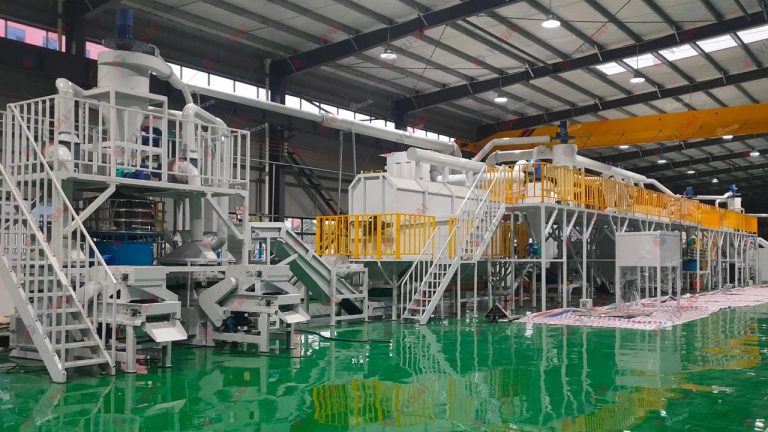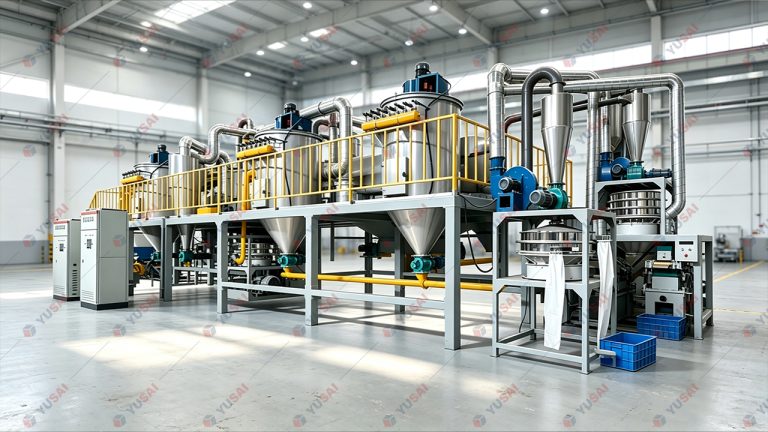
Our lithium battery recycling plant adopts advanced physical separation technology for end-of-life power batteries and consumer digital lithium batteries. The production line safely dismantles spent batteries, separates cathode and anode sheets, and recovers high-value metals and black mass materials, supporting the circular economy of lithium battery resources with safe, low-pollution and high-efficiency pretreatment solutions.
1. Overview
The fast-growing application of lithium batteries in electric vehicles, consumer electronics and energy storage brings a sharp rise in waste battery output. Improper disposal will trigger fire risks and release harmful substances, threatening ecological environment and human health. Our physical recycling process is designed to standardize the whole flow from battery receiving, sorting, safe storage, discharging, controlled dismantling to multi-stage physical separation. Compared with full chemical or pyrometallurgical routes, physical separation cuts chemical consumption and exhaust emission, improves the purity of intermediate materials and creates stable raw materials for subsequent metal refining.
This recycling system handles mixed incoming materials including EV power batteries, pouch cells, cylindrical batteries, hard-case digital batteries and defective cells. All operators receive professional safety training, and the workshop is equipped with fire prevention, explosion protection, static elimination and emergency response facilities.
2. Collection & Safe Storage of Spent Lithium Batteries
Spent lithium batteries are collected by classification, separated from general waste by battery type, voltage and appearance condition. Leak-proof, flame-retardant and explosion-proof collection containers are marked with clear warning labels. Batteries are handled gently to avoid extrusion, puncture and collision.
- Consumer batteries from mobile phones, tablets and small electronics are delivered to designated collection hubs and transported to the recycling plant in batches.
- Large EV battery packs are collected by certified professional teams with qualified transport safety measures.
The storage area keeps away from heat sources, open flame and water, with continuous ventilation. Damaged, swollen and risky batteries are stored in isolated zones. Ambient temperature is controlled below 30°C. Fire sand, special fire extinguishers and first-aid kits are configured on site.
3. Pretreatment: Discharging and Dismantling
Before crushing and separation, all spent batteries go through safe discharging to reduce cell voltage to a safe range. Temperature and voltage are monitored in real time during discharging to avoid thermal runaway. After discharging, batteries enter the closed dismantling station. Workers wear complete protective gear while mechanical equipment removes shells, modules and connecting structures. Dismantled fractions are sorted preliminarily: casing, plastic, separator, cathode sheets, anode sheets and other components.
4. Core Physical Separation Process
Our production line relies on physical sorting without heavy acid leaching or direct incineration as the main process. Multi-stage classification units work sequentially to liberate and separate materials according to differences in density, particle size, magnetism and conductivity.
- Crushing and screening: Controlled crushing liberates active materials from copper and aluminum foils. Sieving classifies materials by particle size, capturing fine black mass and separating coarse metal foils and plastic fragments.
- Gravity separation: Air classification and gravity tables separate light separator/plastic fractions from heavy metal particles and electrode powder based on density gaps.
- Magnetic separation: Removes iron and ferromagnetic shell scraps from mixed materials.
- Eddy current & electrostatic separation: Separates conductive copper, aluminum foils from non-conductive separator and plastic residues, further purifying cathode and anode concentrates.
Through this integrated physical route, we realize effective separation of cathode sheets, anode sheets, copper, aluminum and black mass. The obtained black mass contains lithium, cobalt, nickel, manganese and graphite, which can be supplied as high-quality feedstock for hydrometallurgical refining.
5. Hazardous Substance Control & Environmental Protection
The whole line runs under negative pressure closed collection to contain dust and volatile organic gas. Residual electrolyte is captured and treated by adsorption and distillation to meet emission standards. Wastewater, solid residues and noise are managed under local environmental regulations. Regular environmental monitoring is implemented to keep the production process eco-friendly.
6. Safety Management
Standard SOPs are enforced for every station. Fire suppression, explosion isolation and anti-static systems run synchronously with production. Equipment inspection and maintenance are scheduled regularly to eliminate hidden risks. All personnel follow safety operation rules for battery feeding, dismantling and powder handling.
7. Product Output & Application
Main recyclable outputs from our physical recycling line:
- Copper foil, aluminum foil
- Cathode concentrate and anode concentrate
- Black mass (black powder) rich in lithium, cobalt, nickel, manganese and graphite
- Plastic and iron shell scraps
These recycled materials can be traded directly or sent to downstream metallurgical plants for further extraction of battery-grade metals, closing the lithium battery material loop.
8. Conclusion
Our lithium battery recycling physical separation line provides a stable, scalable and environmentally responsible pretreatment solution for mixed spent power batteries and digital batteries. It achieves safe dismantling, efficient separation of cathode and anode sheets and stable recovery of metals and black mass. We support custom layout of recycling capacity for global partners and supply reliable pretreatment equipment and process technology for lithium battery circular projects.