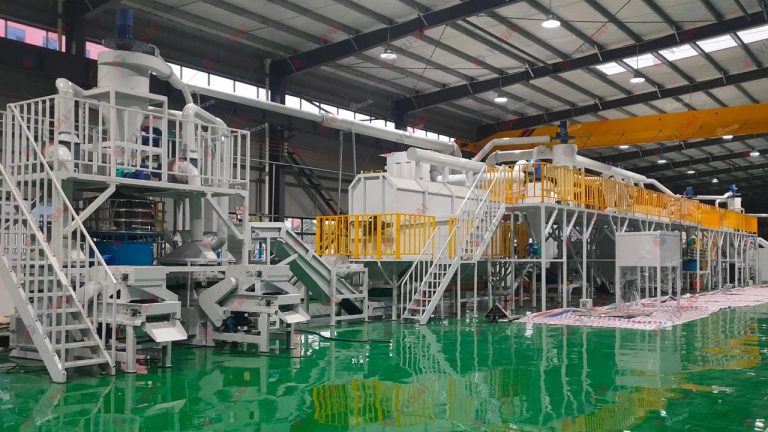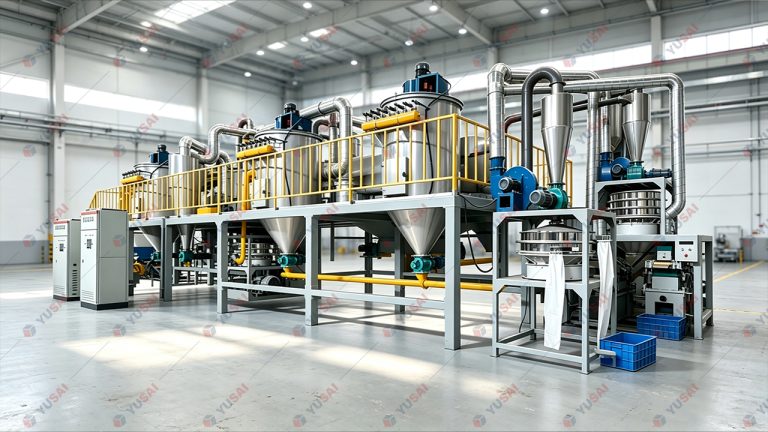
When comparing lithium‑ion battery recycling crushing equipment on the global market, buyers often notice a puzzling reality: units that look similar on brochures can deliver drastically different recovery performance for black mass, copper, aluminium and critical battery metals.
Recovery rate gaps do not mainly come from the crusher rotor itself. The real differences lie in material liberation quality, multi‑stage separation configuration, fine‑dust capture capacity, process‑to‑feedstock matching, and even how vendors define performance metrics. This article breaks down the core root causes to help recycling project investors avoid common pitfalls.
1. Crushing & Liberation Logic: It Is Not About Finer Grinding, But Selective Peeling
Crushing spent lithium‑ion batteries is never simply “grind everything small”. The target is to peel cathode/anode black mass off copper‑aluminium current collectors, without over‑pulverising copper and aluminium foils into micro‑powders that get lost in dust or mixed into black mass.
- Low‑cost basic solutions: Single‑stage hammer shredding only. Black mass remains stuck onto metal foils and flows into copper‑aluminium fractions; or excessive grinding turns copper/aluminium into ultra‑fine particles that escape separation. LFP (Lithium‑Iron‑Phosphate) batteries feature strong PVDF binder adhesion. Without thermal debonding pretreatment, liberation efficiency stays inherently poor.
- Advanced integrated lines: Gradient shredding combined with controlled low‑oxygen thermal pretreatment removes electrolyte, separators and organic binders before fine crushing. Electrode materials are cleanly detached from foils. This step sets the upper limit of your whole‑line recovery performance.
2. Separation Workflow: More Than One Round of Screening and Air Classification
Many suppliers sell crushing machines equipped only with simple vibrating sieve plus single‑pass air sorting. Premium recycling systems adopt cascaded separation combinations: size classification, gravity‑based air separation, magnetic separation, eddy‑current separation plus secondary scavenging re‑processing for tail residues.
- Simplified setups: Coarse and fine fractions mix together. Light aluminium fragments, separator plastic and fine black mass interfere mutually. Black mass leaks into tailing waste, while copper‑aluminium fractions carry heavy black‑mass contamination. Both material purity and recovery drop sharply.
- Complete engineered workflow: Feedstock is classified by particle size first. Coarse particles go through eddy‑current sorting for copper‑aluminium enrichment; medium fractions apply gravity separation; ultra‑fine black mass is collected independently. Tailings from primary separation return for secondary scavenging recovery. Omitting this scavenging loop can directly cut total recovery by 5‑10 percentage points in continuous industrial runs.
3. Negative‑Pressure Dust Collection & Micro‑Powder Capture: The Invisible Loss Source
Black mass consists of ultra‑fine particles. Poor sealing, inadequate negative‑pressure balance, unsuitable filter bags or ineffective filter cleaning will lead valuable fine powder to escape through exhaust gas — this creates large hidden metal loss that many investors overlook during equipment inspection.
High‑performance lithium‑battery recycling lines adopt full‑sealed negative‑pressure architecture with graded dust‑collecting hoppers with material return design. All captured dust is fed back into the process loop, rather than treated as disposable waste. Many low‑priced systems cut corners on dust‑removal hardware, showing attractive hourly throughput on paper yet suffering constant black‑mass loss in actual production.
4. Matching Between Process Equipment and Real‑World Feedstock
Even using identical hardware, recovery rates shift significantly when feedstock conditions change.
- Battery chemistry difference: NMC ternary, LFP, pouch, cylindrical and prismatic modules differ in binder strength and foil thickness. Fixed‑parameter equipment performing well on ternary waste may under‑perform heavily when processing LFP feedstock.
- Incoming material status: Pre‑discharge completion level, swollen/leaking cells, mixed battery waste, large volumes of BMS wiring and outer casings all disturb separation stability. Heavier impurity loads push down recovery results.
- Operation & maintenance: Rotor gaps, blade wear, air‑flow velocity, eddy‑magnet clearance require periodic calibration. Without regular maintenance, recovery figures drift lower month‑by‑month. Many buyers only reference lab‑scale clean‑cell trial data instead of continuous mass‑production performance.
5. Marketing Metric Misinterpretation: Output Yield vs True Elemental Recovery
A critical trap in vendor quotation comparison: some manufacturers quote “black‑mass output ratio”, not actual elemental recovery of Li‑Ni‑Co‑Mn‑Cu‑Al. High black‑mass output may contain heavy copper‑aluminium and plastic impurities. When sent to downstream hydrometallurgical refining, real metal recovery remains low.
Qualified project acceptance needs full‑stream metal mass‑balance auditing: weigh input feedstock, test metal content of black‑mass product, copper‑aluminium concentrates, tail slag and collected dust. Judging performance purely by powder output volume is misleading.
Typical Industrial Recovery Benchmarks (Steady Continuous Production)
表格
| Solution Type | Comprehensive Black‑Mass Recovery Performance | Notes |
|---|---|---|
| Stand‑alone crusher + single‑stage air sorting | 70%‑82% | High black‑mass carry‑over in metal fractions, large tail‑loss |
| Full‑process line with thermal pretreatment, multi‑grade separation & tail‑scavenging | 88%‑95% | High‑purity black‑mass and copper‑aluminium output, controllable tail‑residue loss |
Practical Checklist for Your Lithium‑Battery Recycling Project Tender
- Confirm whether thermal debonding pretreatment, multi‑level separation and tail‑residue scavenging recovery are included in scope.
- Clarify contracted indicators: require element‑wise metal recovery rate instead of simple black‑mass output ratio; add lab‑testing clauses for tail slag and collected dust within your contract.
- Prioritize real‑world continuous production references matching your feedstock type (NMC / LFP / mixed EV modules), rather than short lab pilot test reports.
- Verify full‑sealed negative‑pressure dust‑return system configuration to rule out invisible fine‑powder losses.
If you are planning a lithium battery recycling project, evaluate the whole process solution carefully instead of judging only by the appearance and price of crushing equipment.