
LFP Battery Recycling Plant
— Turnkey LFP Battery Recycling Plant
The LFP Battery Recycling Plant is a turnkey lithium iron phosphate (LiFePO₄) battery recycling system that converts spent LFP batteries and black mass into battery-grade lithium carbonate (Li₂CO₃) and iron phosphate (FePO₄) — the two feedstocks the LFP battery industry needs most. Combining nitrogen-protected mechanical pretreatment with a proven selective-leaching hydrometallurgy process, the plant delivers 95% lithium recovery, dual saleable products, closed-loop water recycling and full compliance with international environmental standards.
Product Overview
Lithium iron phosphate (LFP) has become the world’s fastest-growing battery chemistry, powering electric vehicles, energy storage systems, buses, e-bikes and industrial equipment. Its advantages — intrinsic safety, long cycle life, low cost and no cobalt — have made it the chemistry of choice for mass-market electrification. But every LFP battery eventually reaches end of life, and the first large retirement wave has already begun.
An LFP Battery Recycling Plant turns this fast-growing waste stream into a strategic raw-material supply. Unlike ternary (NCM/NCA) batteries, LFP contains no cobalt or nickel; its economic value is concentrated in lithium, which makes up roughly 3% of black mass by weight — equivalent to about 150–200 kg of lithium carbonate per tonne of black mass. Recovering that lithium is not only profitable, it is becoming mandatory: the EU Battery Regulation (EU) 2023/1542 sets recycled-content quotas, and a growing number of countries now require licensed, environmentally compliant treatment of spent batteries.
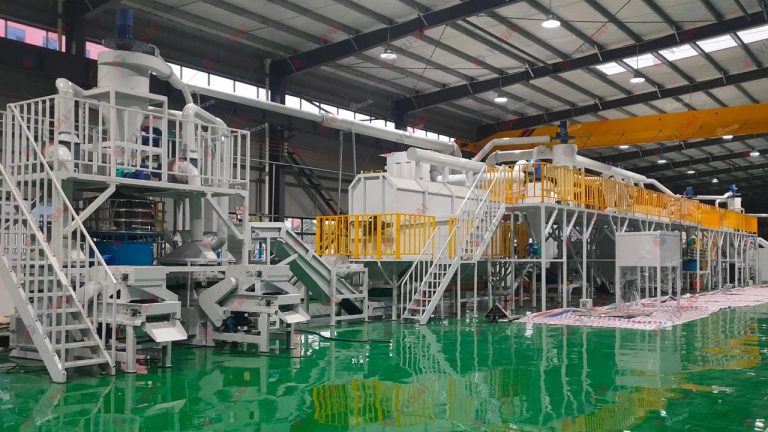
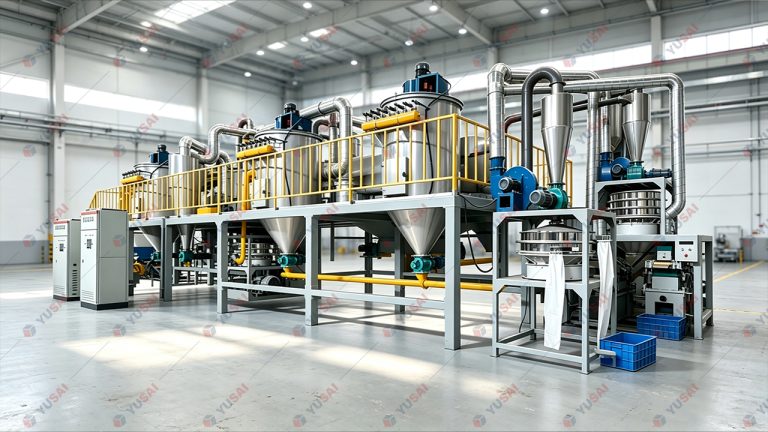
The YuSai LFP Battery Recycling Plant covers the complete route from whole battery to finished lithium salt in one integrated line:
- Pretreatment stage — deep discharge (or inert-gas live crushing), dismantling, nitrogen-protected shredding, thermal treatment and multi-stage sorting to liberate clean LFP black mass, copper, aluminum and plastics;
- Hydrometallurgical stage — selective oxidative leaching with sulfuric acid, solid-liquid separation, purification and hot sodium-carbonate precipitation to produce lithium carbonate and iron phosphate at battery-grade quality.
Every plant is engineered as an EPC package around the customer’s actual feedstock: YuSai first tests a sample of your black mass or batteries in our laboratory, then designs the process flow, manufactures the equipment, installs and commissions the line, and trains your operators. Standard modular capacities suit new recyclers and expanding plants alike, and the same platform can be configured to also accept ternary or mixed black mass when your business grows.
Recycling Value Analysis
Where the Value Comes From
A spent LFP battery is not waste — it is a packaged resource. Its recoverable value is distributed across four streams:
Lithium (the profit engine). LFP black mass typically assays 2.7–3.2% lithium. At 3.0% Li, one tonne of black mass carries roughly 160 kg of lithium-carbonate equivalent; at the plant’s 90–95% recovery, that becomes ~145–155 kg of saleable Li₂CO₃ per tonne of feed. Lithium carbonate is where the business case is made — its price tracks the global lithium market, and battery-grade material commands a clear premium over industrial grade.
Iron & phosphorus (the second product). In the selective-leaching process, iron and phosphorus are not lost: they report directly to the leach residue as high-purity iron phosphate (FePO₄·2H₂O), a saleable product for phosphate chemicals, or a precursor for regenerating new LFP cathode material as closed-loop LFP production scales.
Copper, aluminum & plastics (the front-end harvest). Pretreatment recovers copper foil and aluminum (casing, busbars, foil) at high purity for direct sale to metal traders, plus clean plastic and steel fractions — revenue that pays for the pretreatment step itself.
Environmental & compliance value (often underestimated). Licensed recycling converts a hazardous-waste liability into a compliant business: no disposal fees, no regulatory risk, and documented carbon savings from recycled vs. mined lithium — increasingly valuable for ESG reporting and for selling into EU-regulated markets.
Economic Model (industry-benchmarked)
- Typical LFP recycling cost ≈ ¥8,500/tonne of spent batteries (disassembly, wet-process lithium extraction, environmental compliance); typical regenerated value ≈ ¥9,000/tonne, a 5–10% margin at current prices — and the margin widens when battery-grade (not industrial-grade) Li₂CO₃ is produced.
- Global lithium battery recycling market is projected to exceed $10 billion by 2030, with China accounting for over half.
- Profit sensitivity: every percentage point of lithium recovery gained is nearly pure margin, which is why the YuSai process is engineered around priority lithium leaching rather than back-end recovery — back-end routes lose lithium at every purification step and typically recover only 50–70%.
YuSai provides a free feasibility calculation based on your local Li₂CO₃ price, black mass sourcing cost and planned volume before you invest.
Applicable Materials
The plant accepts the full range of lithium iron phosphate feedstocks, from whole packs to refined powder:
- Spent LFP battery packs — EV traction batteries, energy storage system (ESS) batteries, buses, e-bikes, forklifts, low-speed vehicles
- LFP cells and modules — prismatic, cylindrical and pouch formats
- LFP production scrap — off-spec cells, end-of-line rejects from battery plants
- Electrode scrap — cathode/anode coils, defective coated foil, LFP electrode slurry
- LFP black mass — pre-crushed cathode/anode powder purchased from upstream processors
Typical LFP black mass composition (reference test report; process is designed around your actual assay):
- Li ~2.7–3.2% · Fe ~21% · P ~13% · Cu ~2–3% · Al ~1% · C ~30% (carbon black + graphite)
Send 1–5 kg of your material to our lab: we return a full assay, a leach test report and a finished Li₂CO₃/FePO₄ sample before you commit.
Product Structure (Main Equipment)
Stage 1 — Pretreatment Line (battery to black mass)
- Discharge system — salt-bath or discharge racks bring packs/cells to a safe voltage before processing; alternatively, YuSai’s inert-gas live-crushing option eliminates the discharge step entirely (see Section 7).
- Dismantling & cutting station — removes battery cases, BMS, wiring harness and busbars; steel and electronics are routed to scrap streams.
- Nitrogen-protected shredder — primary shredding under an inert-gas atmosphere with O₂ monitoring, eliminating ignition risk from residual charge and electrolyte.
- Thermal treatment furnace (optional) — removes residual electrolyte and decomposes the PVDF binder at 450–550 °C in a non-oxidizing rotary kiln, stabilizing the powder before leaching.
- Sorting & separation train — vibrating screens, air classifiers, magnetic separator and (optional) electrostatic separator liberate clean black mass from copper foil, aluminum foil, plastics and steel.
- Exhaust treatment for pretreatment — bag filters, semi-dry defluorination and RTO thermal oxidation for the fluorine-bearing organic off-gases (see Section 13).
Outputs: LFP black mass, copper foil, aluminum, steel, plastics.
Stage 2 — Hydrometallurgical Refinery (black mass to lithium carbonate)
- Leaching reactors — jacketed, corrosion-resistant (PP/FRP-lined or 316L) tanks where H₂SO₄ + oxidant selectively dissolve lithium as Li₂SO₄ while iron and phosphorus precipitate as FePO₄·2H₂O.
- Membrane filter press — separates the FePO₄·2H₂O cake from the lithium sulfate solution; cake washing included.
- Purification tanks — pH-controlled chemical precipitation removes residual Cu, Al, Ca, Mg and Fe to the ppm/ppb targets required for battery-grade salt.
- Precipitation reactor — heated (90–100 °C) sodium-carbonate precipitation converts purified Li₂SO₄ to Li₂CO₃ crystals.
- Washing, drying & packaging line — counter-current washing, flash/rotary drying and bagging to 25 kg/500 kg/1 t specification.
- MVR evaporation & crystallization (optional) — recovers lithium from mother liquor and recycles process water.
- Wastewater treatment unit — neutralization and heavy-metal precipitation for closed-loop water operation.
- Acid-mist scrubber — negative-pressure collection and scrubbing of leaching fumes.
- PLC control system — automated dosing, temperature, pH and level control with alarm and batch data logging.
Process Flow
Overall Route: Spent LFP Battery → Battery-Grade Lithium Carbonate

Core Chemistry
Selective oxidative leaching. With oxygen or hydrogen peroxide as oxidant, lithium is leached selectively into solution while iron and phosphorus stay in the residue as iron phosphate — no iron-reduction step, no additional reagent:
4LiFePO₄ + 2H₂SO₄ + O₂ ⟶ 2Li₂SO₄ + 4FePO₄↓ + 2H₂O
Hot carbonate precipitation. Purified lithium sulfate is converted to lithium carbonate by soda ash at 90–100 °C:
Li₂SO₄ + Na₂CO₃ ⟶ (90–100 °C) Li₂CO₃↓ + Na₂SO₄
Stage-by-Stage Description
- Discharging — packs/cells are deep-discharged to a safe voltage in a salt bath or on discharge racks, removing residual-energy risk before mechanical work.
- Dismantling & sorting — cases, BMS, wiring and busbars are removed; steel and electronic scrap are recovered for sale.
- Inert-gas shredding — cells are shredded under nitrogen with O₂ monitoring; the sealed system keeps dust and electrolyte vapors inside the gas treatment circuit.
- Thermal treatment (optional but recommended) — a non-oxidizing rotary kiln at 450–550 °C for 0.5–2 h volatilizes residual electrolyte and decomposes the PVDF binder (releasing HF, which is captured by the defluorination system). Result: a stable powder with higher leach efficiency and no binder interference.
- Sorting — vibrating screens and air classifiers separate coarse copper/aluminum from fine powder; magnetic and electrostatic separators refine the metal fractions. Black mass of ≥90% purity reports to the refinery.
- Selective leaching — the black mass is leached in sulfuric acid with an oxidant at 60–80 °C for ~2–3.5 h. The end pH is controlled near neutral: Li enters the liquor as Li₂SO₄; Fe and P report to the residue as FePO₄·2H₂O.
- Solid-liquid separation — a membrane filter press separates and washes the iron phosphate cake; the lithium sulfate filtrate flows to purification.
- Purification — pH adjustment and chemical precipitation remove Cu, Al, Ca, Mg and residual Fe, producing a clean lithium sulfate solution.
- Hot precipitation — soda ash is added at 90–100 °C; Li₂CO₃ crystals precipitate and are washed counter-currently to remove sodium sulfate.
- Drying & packaging — flash or rotary drying to specification, then packaging to customer requirements.
Optional upgrade path: the purified lithium sulfate solution can instead be routed to a bipolar-membrane electrodialysis (BPED) module to produce battery-grade lithium hydroxide (LiOH·H₂O) — the higher-value lithium salt demanded by next-generation LFP cathode makers.
Product Features
- Priority lithium leaching — 95% lithium recovery. Lithium is leached first, in one concentrated step, instead of being recovered at the back end where every purification stage loses it. Recovery climbs from the industry’s typical 50–70% to 90–95%.
- Dual saleable products. Battery-grade/industrial-grade lithium carbonate plus high-purity iron phosphate (FePO₄·2H₂O) — two revenue streams, plus copper, aluminum and plastics from pretreatment.
- Safety-engineered pretreatment. Nitrogen-protected shredding with O₂ monitoring, optional live-crushing that eliminates the discharge step, and sealed gas handling — no fire risk, no electrolyte exposure.
- Clean, fluorine-aware gas treatment. Pretreatment off-gases pass through bag filtration, semi-dry defluorination and RTO thermal oxidation; leaching fumes are scrubbed under negative pressure. HF is captured before it reaches the atmosphere or wastewater.
- Closed-loop water system. MVR evaporation and wastewater treatment recycle over 90% of process water; minimal external discharge simplifies permitting.
- Corrosion-resistant wet section. PP/FRP-lined reactors and 316L contact parts are built for years of sulfuric-acid service.
- Full PLC automation. Dosing, temperature, pH and level are controlled automatically with batch data logging — fewer operators, reproducible product quality.
- Modular, scalable, feed-flexible. Standard modules expand as feedstock grows; the same platform can be configured for LFP-only or LFP + ternary/mixed black mass.
- Turnkey EPC delivery. Sample testing → process design → manufacturing → installation → training — one responsible partner from inquiry to production.
- Optional battery-grade LiOH upgrade. A bipolar-membrane electrodialysis module converts purified Li₂SO₄ into higher-value battery-grade lithium hydroxide.
Technical Parameters
Pretreatment Line Parameters
| Parameter | Design Value |
|---|---|
| Feedstock | Spent LFP packs, cells, modules, electrode scrap |
| Discharge | Salt-bath / discharge rack (or optional inert-gas live crushing) |
| Shredding atmosphere | Nitrogen-inerted, O₂ monitored |
| Thermal treatment | Rotary kiln, 450–550 °C, non-oxidizing (optional) |
| Black mass purity after sorting | ≥ 90% |
| Recovered metals | Copper ≥ 95% purity, aluminum ≥ 92% purity (typical) |
| Off-gas treatment | Bag filter + semi-dry defluorination + RTO / alkali scrubbing |
| Control system | PLC automatic with safety interlocks |
Hydrometallurgical Refinery Parameters
| Parameter | Design Value |
|---|---|
| Feedstock | LFP black mass / spent LFP batteries (assay-based design) |
| Lithium recovery rate | ≥ 90%, typically 90–95% (priority leaching) |
| Li₂CO₃ purity — industrial grade | ≥ 99.0% |
| Li₂CO₃ purity — battery grade | ≥ 99.5% |
| FePO₄·2H₂O purity | ≥ 97% |
| Leaching system | H₂SO₄ + O₂ / H₂O₂, selective oxidative leaching |
| Leaching temperature / time | 60–80 °C / 2–3.5 h |
| Precipitation temperature | 90–100 °C (hot Na₂CO₃ route) |
| Water recycle rate | ≥ 90% (closed loop) |
| Control system | PLC automatic, batch data logging |
| Corrosion protection | PP/FRP-lined reactors, 316L contact parts |
| Capacity | Modular, scalable to feedstock volume (custom-engineered) |
Indicative design values; final parameters are engineered to your feedstock assay, capacity and site conditions. YuSai removes the guesswork with a laboratory leach test on your material before design.Specifics such as footprint, installed power and utility demand are provided with the process proposal for your exact line size.
Advantages
- One supplier, whole line. Both the pretreatment line and the hydrometallurgical refinery are manufactured in-house by YuSai — matched interfaces, single warranty, one accountable partner.
- Test before you buy. YuSai’s lab runs an assay and leach test on your actual black mass and ships you the finished Li₂CO₃/FePO₄ samples and a recovery report. You invest based on evidence, not promises.
- Engineered around your feed. Acid strength, oxidant choice, temperature profile and equipment sizing follow your lithium grade and impurity profile — not a one-size-fits-all template.
- Process economics by design. Selective leaching consumes less acid and energy than full co-leaching routes; priority lithium recovery captures the margin that back-end routes lose.
- Higher-value products, higher margins. Battery-grade Li₂CO₃ (≥99.5%) and the optional LiOH upgrade command prices well above industrial-grade output.
- Global compliance package. CE certification, ISO 9001 quality system and full engineering documentation (P&ID, layout, foundation drawings, manuals) support your EIA and export requirements.
- Proven international delivery. YuSai engineers install and commission plants worldwide and provide lifetime remote support and spare parts at cost.
- Honest project guidance. We tell you which capacity, chemistry and configuration makes economic sense in your market — including a free feasibility and payback calculation.
Service Process
- Inquiry — share your feedstock type, daily volume, site conditions and timeline (see the five questions in FAQ).
- Sample testing — send 1–5 kg of black mass or a representative battery; YuSai’s lab returns assay, leach report and finished product samples.
- Solution design — process flow, equipment list, layout and foundation drawings, utility requirements and emission design, all customized.
- Quotation — transparent commercial proposal (EXW/FOB/CIF), spare-parts list, payment terms.
- Contract — formal agreement with delivery schedule and warranty terms.
- Manufacturing — fabrication with milestone progress updates and photos.
- Inspection & trial run — pre-shipment commissioning at the YuSai factory; third-party inspection optional.
- Shipping — seaworthy export packing, full documentation, freight coordination.
- Installation & commissioning — YuSai engineers supervise installation and run the line to full production at your site.
- Training — operator training on process control, safety and maintenance; manuals in English (local language on request).
- After-sales support — 24/7 remote support, spare parts at cost, technology upgrades for the life of the plant.
Warranty & After-Sales Service
- 12-month warranty from commissioning (extendable to 24 months by agreement) covering manufacturing defects in materials and workmanship.
- Lifetime technical support — process consulting, troubleshooting and chemistry optimization whenever you need it.
- Spare parts at factory cost — filter cloth, seals, dosing pumps, sensors and other consumables shipped worldwide from our parts database.
- 24/7 remote assistance — WhatsApp/email/video support from English-speaking engineers, response within 24 hours.
- On-site service — engineers dispatched for major issues (visa and logistics arranged by us, costs by agreement).
- Technology upgrades — retrofit options as process chemistry and automation improve, keeping your plant competitive.
- Documentation retention — drawings, certificates and manuals archived permanently and re-issued on request.
FAQ (Frequently Asked Questions)
Q1: What raw materials can this plant process?
A: Spent LFP battery packs (EV, ESS, e-bike, forklift), LFP cells and modules in all formats, production scrap and off-spec cells, electrode scrap and purchased LFP black mass. Send us 1–5 kg for a free assay and leach test to confirm your process parameters and recovery.
Q2: What are the final products and who buys them?
A: Lithium carbonate (Li₂CO₃ ≥99.0% industrial / ≥99.5% battery grade), iron phosphate (FePO₄·2H₂O), plus copper and aluminum scrap. Li₂CO₃ is sold to battery material makers, glass/ceramics and chemical industries; FePO₄ goes to phosphate chemical producers or is regenerated into LFP cathode material; metals go to metal traders.
Q3: What lithium recovery rate can I expect?
A: 90–95% lithium recovery through priority leaching — versus the 50–70% typical of back-end recovery routes. With a 3.0% Li black mass, expect roughly 145–155 kg of Li₂CO₃ per tonne of feed at 90–95% recovery. Your actual rate is confirmed by the free lab test before purchase.
Q4: What does it cost, and is it profitable?
A: Industry benchmark for LFP recycling is roughly ¥8,500/tonne of spent batteries in processing cost against ~¥9,000/tonne in regenerated value — a 5–10% margin at current prices that widens when you produce battery-grade Li₂CO₃. YuSai provides a free feasibility calculation using your local prices.
Q5: How do I choose the right capacity?
A: Size the line for the feedstock volume you can reliably source over the next 2–3 years. Standard plants are modular and expandable; we recommend starting at the volume that matches your black mass supply and budget, then scaling up. Our engineers advise on the configuration that pays back fastest in your market.
Q6: Can it also recycle NMC/ternary batteries?
A: The pretreatment section handles LFP, NMC and mixed chemistries. The refinery can be configured as a dual-chemistry line (LFP + NMC) with additional purification and extraction steps if you plan to process both.
Q7: How long from order to production?
A: Manufacturing typically takes 45–90 days depending on line size; site installation and commissioning takes 2–4 weeks with YuSai engineers. A detailed schedule is written into the contract.
Q8: How do I get a quotation?
A: Send us (1) raw material type, (2) tons per day, (3) project start date, (4) budget range, and (5) your key concerns — recovery rate, automation level, emissions compliance, etc. We reply with a process proposal and quotation within 3–5 working days.
Q9: Is the plant environmentally compliant?
A: Yes. Design includes nitrogen-inerted shredding, fluorine-aware gas treatment (defluorination + RTO + alkali scrubbing), ≥90% water recycling and wastewater treatment. Full documentation supports your EIA application, and recovered lithium helps meet EU Battery Regulation recycled-content obligations.
Q10: What is the difference between this plant and a shredding-only lithium battery recycling line?
A: A shredding-only line stops at black mass and metal fractions, which you must then sell to a refinery. The YuSai LFP Battery Recycling Plant completes the value chain: it refines black mass into battery-grade lithium carbonate and iron phosphate on site, capturing the margin that a black-mass seller gives away.

Get A Free Quote
Tell us your raw material type, daily processing volume and target products — our engineers will reply within 24 hours with a tailored solution and ROI analysis.
- +86 18339216321
- info@yusaipreciousmetals.com
- Zhengzhou, Henan, China
If you be interested in our equipment and solutions, please to contact us.
- +86 18339216321
- info@yusaipreciousmetals.com
- zhengzhou.henan.china