End‑of‑Life Lithium‑Ion Battery: Second‑Life Utilization & Metallurgical Recycling Technologies
As electric vehicles and renewable energy storage industries expand rapidly, large volumes of retired power lithium‑ion batteries are generated every year. End‑of‑life lithium‑ion batteries contain high‑value metals including lithium, cobalt, nickel, manganese, copper and aluminium, yet improper disposal brings heavy‑metal contamination and fire risks. Building circular‑economy workflows for retired batteries covers two major technical directions: echelon (second‑life) utilization and material‑recovery dismantling & recycling. Lithium‑iron‑phosphate (LFP) batteries are more suitable for echelon reuse, while ternary lithium‑ion batteries are mostly processed via metallurgical material recovery.

Echelon / Second‑Life Utilization
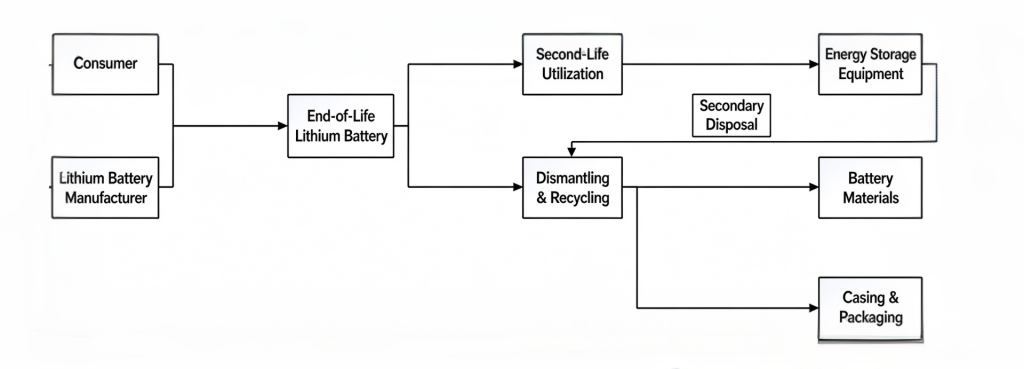
When power lithium‑ion batteries degrade to around 80 % of original rated capacity, they no longer meet strict electric‑vehicle power requirements, but still retain usable residual capacity for less‑demanding energy‑storage scenarios. Echelon utilization maximizes remaining battery value before metallurgical recycling, lowering overall lifecycle cost and cutting raw‑material consumption.
Major practical application scenarios for second‑life batteries:
- Solar‑power supporting storage: Stabilize fluctuating output of standalone photovoltaic systems, deliver continuous power for off‑grid installations.
- Wind‑power energy storage: Smooth intermittent wind‑generation power curves, improve power quality and reliability for both grid‑tied and off‑grid wind facilities.
- Grid peak‑shaving: Store electricity during low‑demand off‑peak hours and release power during peak‑load periods to ease grid supply‑demand pressure for communities and commercial sites.
- Telecom backup power: Retired LFP batteries fit well for floating‑charge backup power of mobile communication base stations.
- Low‑speed mobility: Repurposed battery packs can serve electric bikes and low‑speed electric vehicles.
Echelon reuse requires strict sorting, performance screening, regrouping and battery‑management‑system matching. Batteries failing second‑life screening move forward to dismantling and metallurgical recycling for raw‑material regeneration.
Dismantling & Material‑Recovery Recycling Technologies
Before metallurgical treatment, spent lithium‑ion batteries go through essential pretreatment: safe discharging, mechanical disassembly, crushing, screening and separation to isolate metal shells, current foils and cathode‑anode black‑mass materials. Four mainstream recycling technical routes are available: physical separation, pyrometallurgy, hydrometallurgy, and bio‑leaching. Among them, bio‑leaching remains largely at laboratory research stage and has not achieved large‑scale industrial deployment.
1. Physical Separation Recycling
Physical recycling relies on mechanical crushing, screening, magnetic separation, froth flotation and low‑temperature cryogenic fragmentation (liquid‑nitrogen cooling) to sort out casing plastics, steel, copper foil, aluminium foil and electrode powders without heavy chemical consumption.
Advantages: relatively eco‑friendly, low chemical reagent consumption, simple core principle. Limitations: overall metal recovery efficiency is moderate; cross‑contamination between different metal fractions frequently occurs; processing throughput is limited. Physical separation is often adopted as pre‑treatment for subsequent metallurgical refining instead of standalone final processing.
2. Pyrometallurgical Recycling
Pyrometallurgy (high‑temperature smelting) feeds pre‑sorted battery fragments into high‑temperature arc furnaces. Organic binders, electrolytes and graphite burn inside the furnace, releasing heat to sustain smelting reactions. Nickel, cobalt, copper and iron are concentrated into alloy phases, while lithium and aluminium mostly enter smelting slag, which demands further hydrometallurgical refining to extract lithium salts.
Advantages: simple process flow, high processing capacity, flexible for mixed incoming battery feeds. Limitations: high energy consumption; exhaust‑gas and slag treatment is mandatory for emission control; direct lithium recovery rate is low, requiring follow‑up wet refining to obtain battery‑grade lithium products.
3. Hydrometallurgical Recycling
Hydrometallurgy is currently the most widely‑adopted industrial recycling pathway. After pretreatment, electrode materials go through leaching followed by multi‑step metal separation and purification.
Leaching Section
Leaching dissolves valuable metals from cathode powders. Two primary leaching categories are applied:
- Inorganic‑acid leaching: Sulfuric acid with reducing agents is the mainstream industrial choice. Hydrochloric acid delivers excellent leaching performance yet generates toxic chlorine gas; nitric acid produces nitrogen‑oxide emissions.
- Organic‑acid leaching: Environment‑friendly organic acids such as citric acid, oxalic acid and ascorbic acid reduce corrosive hazards, though higher reagent cost restricts large‑volume production.
After leaching, nickel, cobalt, manganese, lithium, aluminium and iron transfer into aqueous leachate. Target metals are separated and purified by three mature technical approaches:
- Chemical precipitation: Select precipitants including carbonates, ammonium salts and phosphates to precipitate target metals by adjusting pH value. It is easy to operate, yet co‑precipitation may cause metal loss.
- Solvent extraction: Selective organic extractants separate different metal ions, delivering high‑purity metal‑rich solutions for producing battery‑grade precursors. Large extractant consumption and reagent cost are key constraints.
- Electrowinning / electro‑refining: Under applied electric potential, target metal ions are reduced and deposited onto cathodes to obtain high‑purity metallic products. The technique yields high‑quality metal outputs but consumes substantial electric power and requires pre‑purification of leach liquor.
Advantages of hydrometallurgy: high overall metal recovery rate, high‑purity regenerated metal or salt products, relatively moderate operating temperature. Limitations: long process sequences, strict feed‑material sorting requirements, heavy wastewater treatment workload.
4. Bio‑leaching Technology
Bio‑leaching uses metabolically‑produced organic acids from specialized microbes to dissolve valuable metals from battery materials. It features low‑energy operation and low secondary pollution potential. However, strict microbial‑culture conditions, low practical leaching efficiency and unstable process control prevent large‑scale commercial deployment at present.
Economic Characteristics & Combined‑Process Solutions
From practical industrial data, recycling economics differ greatly between battery chemistries:
- Ternary lithium‑ion batteries containing high‑value cobalt, nickel and manganese can generate positive profit across physical, pyrometallurgical and hydrometallurgical workflows.
- LFP batteries hold relatively low intrinsic metal value; standalone dismantling‑recycling usually runs at a loss, making echelon second‑life utilization economically preferable before final material recycling.
No single recycling technology can deliver optimal performance in every dimension. Modern industrial practice increasingly adopts hybrid combined processes: apply physical crushing and sorting for pre‑treatment, combine pyrometallurgical smelting with hydrometallurgical purification, integrating precipitation, solvent extraction and electrowinning units. This hybrid approach compensates for respective drawbacks of individual technologies, boosts total resource‑recovery efficiency, optimizes operating cost and improves final‑product purity for battery‑grade raw‑material remanufacturing.
Outlook
The global lithium‑ion‑battery recycling industry keeps evolving. Future development directions include: improving sorting automation for mixed spent batteries, developing low‑cost green leaching reagents, upgrading waste‑water and exhaust‑gas treatment systems, advancing integrated hybrid recycling workflows, and expanding the commercial scale of echelon energy‑storage applications. Closed‑loop battery recycling will continuously mitigate raw‑material supply pressure and support sustainable development for electric‑mobility and renewable‑energy sectors.