1. Global Market Background & Challenges of Lithium‑ion Battery Recycling
Global demand for lithium‑ion battery recycling equipment keeps rising, driven by booming new‑energy vehicles, energy‑storage systems and consumer electronics. Large quantities of spent EV power batteries, 18650 cells and pouch lithium‑ion batteries reach their end‑of‑life every year.
Improper disposal of waste lithium‑ion batteries will release lithium, cobalt, nickel heavy metals and toxic electrolyte into soil and water, bringing huge risks to ecological safety and public health. Many countries and regions, including the EU with its Battery Regulation, have enforced strict rules for spent battery collection, recycling and recycled‑material content, pushing fast growth of the battery circular economy industry.
However, many investors face common bottlenecks when building a spent lithium‑ion battery recycling plant: high fire risk during battery dismantling, unstable metal recovery rate, non‑compliant dust and exhaust emissions, low automation level, and lack of suitable complete processing lines.
We are a professional original manufacturer of lithium‑ion battery recycling machinery. We deliver full‑set physical pre‑processing recycling lines for global partners, helping you operate safe, eco‑friendly and high‑efficiency waste battery resource recovery projects.
2. Core Design Principles of Our Lithium‑ion Battery Recycling Lines
All our lithium battery crushing and separation lines are engineered for real‑world overseas project compliance, following four key principles:
- Safety First: Effectively prevent battery short‑circuit, fire hazards and electrolyte leakage to protect site staff and factory facilities.
- Environmental Compliance: Built‑in dust removal and waste‑gas treatment modules to meet local emission standards in different countries and avoid secondary pollution.
- Maximize Valuable Material Recovery: Adopt crushing, pyrolysis and multi‑level physical separation technologies to extract copper, aluminium and high‑grade black mass for better project profit.
- Modular Customization: Custom‑engineer full production lines based on your required hourly capacity, battery feedstock types and factory site layout.
Note: Our recycling equipment focuses on physical pre‑processing workflow. Main processes cover battery safe discharging, dismantling, crushing, pyrolysis, air separation, magnetic separation and gravity screening. Output materials include black mass, copper granules, aluminium granules, plastic and battery separators. Subsequent hydrometallurgical purification can connect with third‑party chemical processing facilities.
3. Full Processing Workflow & Supporting Recycling Equipment
Our complete waste lithium‑ion battery recycling system covers all major pre‑treatment steps once spent batteries arrive at your factory. Key units are listed below:
Safe Discharging & Automatic Feeding Unit
Spent lithium‑ion batteries go through complete safe discharging to eliminate short‑circuit and explosion risks. Sealed conveyor systems transport materials to next processing steps and reduce direct manual contact with hazardous battery cells. Matching devices include explosion‑proof feeder and sealed material conveying machines.
Automatic Crushing & Dismantling Unit
Special‑designed shredder and crusher for hard‑shell, pouch and cylindrical lithium‑ion batteries replace risky manual dismantling. Fully‑closed machine structure stops electrolyte volatile leakage and improves overall processing capacity for your recycling plant.
Pyrolysis Treatment Unit
The sealed pyrolysis system decomposes battery electrolyte and binders. It separates cathode active materials from copper‑aluminium foils and improves black mass purity. A supporting waste‑gas purification unit treats organic exhaust gas generated in pyrolysis to achieve compliant discharge.
Multi‑stage Physical Separation Unit (Core Black Mass Recovery System)
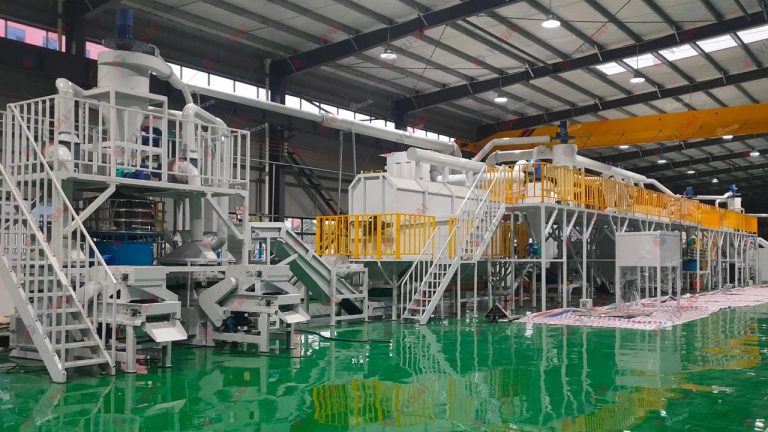
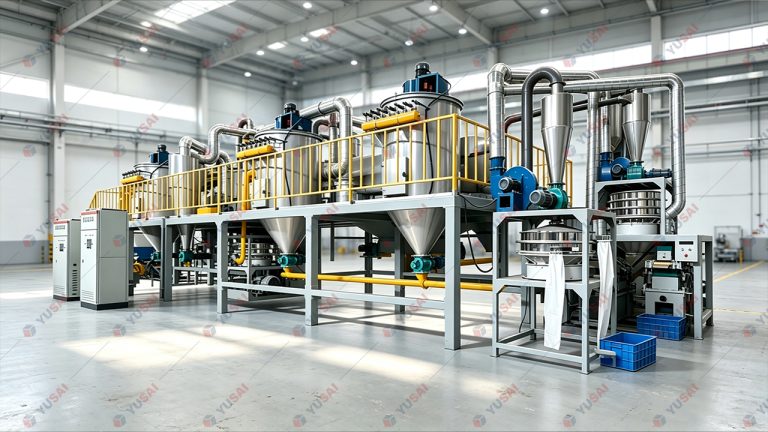
This core module integrates air separator, magnetic separator, gravity separator and screening machines. By leveraging differences in material density and magnetism, the system efficiently sorts black mass, copper metal, aluminium metal, plastic and separators. Recovered copper and aluminium granules can be sold directly, while high‑purity black mass becomes high‑value raw material for battery material factories.
Dust Collection & Waste‑gas Harmless Treatment System
The whole recycling production line works under negative‑pressure sealed conditions. Bag‑house dust collectors capture fine metallic dust. Pyrolysis exhaust goes through condensation and adsorption treatment to remove harmful substances, meeting environmental‑protection requirements for global markets.
PLC Central Intelligent Control System
The PLC control panel monitors real‑time data including equipment temperature, rotation speed and negative‑pressure status. It supports automatic fault alarm and interlock emergency stop functions, lowering operation difficulty for on‑site workers.
4. Main Advantages of Our Lithium‑ion Battery Recycling Equipment for Global Buyers
✅ Flexible modular capacity: Production capacity ranges from 100 kg/h to 3000 kg/h. We supply small pilot recycling lines as well as large‑scale industrial complete plants. Compatible with EV power batteries, laptop & mobile‑phone consumer lithium‑ion batteries and multiple feedstock types.
✅ High‑efficiency material recovery for better ROI: Proven physical separation technology delivers stable black mass, copper and aluminium recovery performance, maximizing economic benefits for your recycling business.
✅ Safety & environmental‑friendly construction: Negative‑pressure closed‑loop production plus explosion‑proof structure and complete air‑pollution control modules. Suitable for projects in Europe, America, Southeast Asia and other regions; reduces your environmental‑impact‑assessment risks.
✅ One‑stop turn‑key related services: Beyond single machine supply, we provide process solution design, factory layout suggestion, equipment manufacturing, overseas on‑site installation guidance, operator training and long‑term after‑sales support.
✅ Custom‑made according to local conditions: Adjust machine configuration for local power voltage, site environment and specific battery materials. Non‑standard recycling equipment customization is available.
5. Ideal End‑Users for Our Battery Recycling Production Line
‑ Lithium‑ion battery recycling factories and hazardous waste treatment enterprises ‑ Retired EV battery treatment projects of new‑energy vehicle manufacturers ‑ Battery material regeneration plants and black mass processing companies ‑ Green‑energy investment firms and circular‑economy industrial parks
6. Industry Outlook & Cooperation Invitation
The global waste lithium‑ion battery recycling industry keeps rapid growth. Stricter international regulations for battery circular economy make high‑quality recycling equipment critical for project success.
As a direct OEM manufacturer, we have delivered custom recycling machinery and integrated solutions for clients across many countries. Whether you want to build a brand‑new recycling plant or upgrade your existing battery processing line, please contact us.
Share your target hourly processing capacity, main battery feedstock and local environmental‑protection requirements. Our engineering team will prepare tailored technical proposal and quotation for your project.